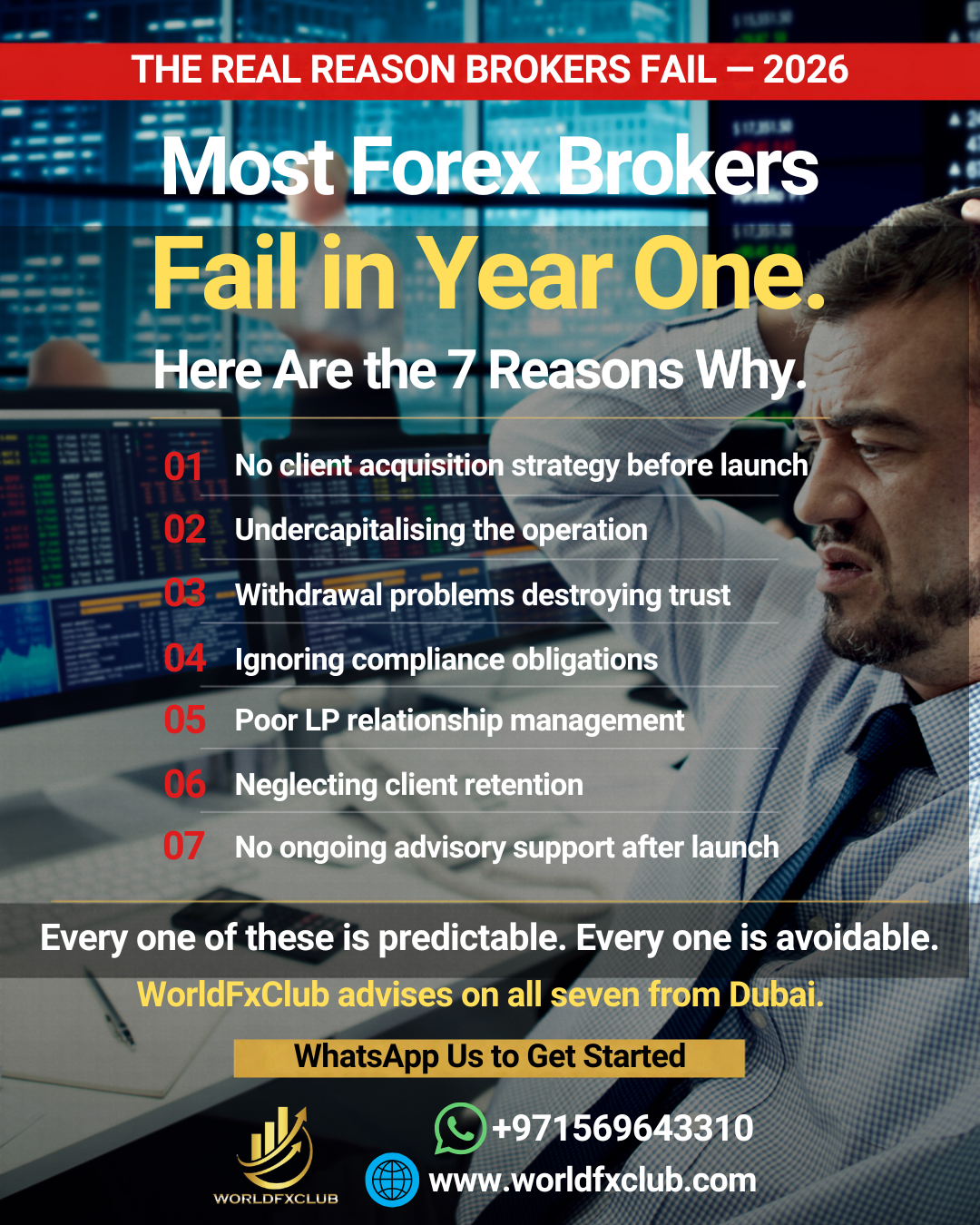
Most forex brokers that launch in 2026 will not make it to their second year.
This is not a pessimistic prediction. It is the reality of an industry where the barriers to entry have fallen dramatically. Launching a broker is easier than ever. However, the operational, commercial and capital challenges of running one remain exactly as demanding as they have always been.
Furthermore, the reasons most forex brokers fail are not mysterious. They are consistent, predictable and — critically — avoidable. Consequently, every broker founder who understands why forex brokers fail before launch is infinitely better positioned than one who discovers these failure points after investing in the setup.
This blog covers the real reasons why most forex brokers fail in the first year — and exactly what to do to avoid each one. WorldFxClub advises on broker setup and ongoing operational support from our Dubai base. Our team helps every founder build a brokerage that survives and scales past the first year.
Why the First Year Is the Most Critical Period
What the First Year Actually Tests
The first year of a forex broker’s operation is not primarily a test of the technology or the corporate structure. The right advisory team sets both of those up correctly in weeks. Furthermore, the first year is not primarily a test of the product offering. Spreads, leverage and trading conditions are all configurable competitively from day one.
The first year tests four things — client acquisition, client retention, cash flow management and operational resilience. Consequently, the brokers that fail in the first year almost always fail in one or more of these four areas. Technology failures and licensing problems rarely cause first-year broker closures.
Understanding this distinction is the most important first step every new broker founder can take. Furthermore, it shifts the focus from the setup phase — where most founders spend the majority of their planning energy — to the operational phase. This is where most of the real commercial challenges actually occur.
Reason 1 — No Client Acquisition Strategy Before Launch
The Most Common and Most Fatal Mistake
The single most common reason forex brokers fail in the first year is launching without a clear proven client acquisition strategy already in place.
Most broker founders spend the majority of their pre-launch time on the setup — the corporate entity, the trading platform, the LP connection, the CRM. Furthermore, these are all essential and all must be done correctly. However, on the day the broker goes live — there are zero clients. Consequently, the broker has a fully functioning trading infrastructure with nobody trading through it.
A broker that launches with no clients generates zero spread revenue from day one. A fully functioning technology infrastructure cannot compensate for an empty client base. Furthermore, monthly operational costs must be covered entirely from the founder’s capital. These include LP fees, CRM subscription, platform fees and payment processor fees — until the client base reaches self-sustaining volume.
Without an incoming revenue stream, most founders exhaust their capital within three to six months. Consequently, they are forced to close the operation before it reaches commercial viability.
How to Avoid It
The founders who succeed in the first year are almost always the ones who solve the client acquisition problem before the broker launches — not after.
Build the audience before you build the broker. The most successful first-year brokers in 2026 are built on top of existing communities — Telegram groups, YouTube channels, TikTok followings, WhatsApp networks, IB referral networks. Consequently, on launch day the broker already has an audience primed and ready to become clients.
Announce the launch through your existing content. The broker launch announcement is one of the most powerful content moments a trading educator or IB can have. Furthermore, announcing that you have built your own brokerage — for your community, built the way you know it should be built — converts followers into clients simultaneously while building the brand.
Have a day-one IB structure ready. Even if the broker itself is new, the IB network that feeds clients into it can be established before launch. Furthermore, WorldFxClub advises on IB structure design for every new broker client. This ensures the partner network is operational from day one rather than built from scratch after launch.
Reason 2 — Undercapitalising the Operation
Running Out of Money Before the Business Works
The second most common reason forex brokers fail in the first year is running out of capital before the broker reaches the trading volume needed to cover its operational costs.
Most first-time broker founders budget for the setup costs — the corporate entity, the trading platform, the LP connection. Furthermore, many also budget for the first one to two months of operational costs. However, very few budget for the full runway required. Building a broker client base to self-sustaining volume typically takes three to six months — and sometimes longer.
Consequently, the broker runs out of capital before it reaches the volume needed to cover its costs. The founder is then forced to close or pause the operation at exactly the point where momentum was beginning to build.
How to Avoid It
Budget for six months of operational costs before launch. The setup cost is the visible investment. However, the operational runway — the capital needed to cover monthly costs while the client base grows to self-sustaining volume — is the invisible investment that most founders underestimate. Furthermore, WorldFxClub provides a complete capital planning breakdown during the free initial consultation. This covers setup costs, ongoing monthly operational costs and the recommended capital buffer for the covering account and withdrawal liquidity reserve.
Maintain a capital buffer in the covering account. Every STP broker must maintain adequate capital in the covering account to cover the leverage gap between LP leverage and retail client leverage. Furthermore, undercapitalising the covering account creates operational risk. This disrupts the entire brokerage when client positions move against the broker’s LP margin. Consequently, WorldFxClub advises on covering account capital planning before every broker launch.
Generate revenue from the first day. The brokers that survive the first year start generating spread revenue from the first week of operation. Furthermore, this requires having clients ready to trade on launch day. This brings the solution back to Reason 1 — client acquisition before launch is both the revenue solution and the capital management solution.
Reason 3 — Withdrawal Problems Destroying Client Trust
The Most Commercially Damaging First-Year Failure
Payment infrastructure — the systems that allow clients to deposit into and withdraw from their trading accounts — is the single most commercially sensitive operational function of any retail forex broker. Furthermore, this is the area where most first-year brokers fail their clients most visibly and most damagingly.
Delayed withdrawals are the number one reason traders leave brokers. Furthermore, in community-built brokerages the founder’s personal reputation is the primary commercial asset. A single serious withdrawal problem can destroy years of community-building work in days. Consequently, withdrawal management is not an operational detail to figure out after launch. It is a business-critical system that must be in place and tested before the first client deposits.
How to Avoid It
Prioritise payment infrastructure from day one of setup. EMI account applications, PSP onboarding and payment channel configuration take time — often more time than the corporate incorporation and platform setup combined. Consequently, start the payment infrastructure setup at the same time as the corporate entity — not after.
Test every withdrawal pathway before going live. Test every payment channel end to end before accepting the first client deposit. Furthermore, testing must include the full withdrawal cycle — from client withdrawal request through to funds received — so any friction points are identified and resolved before they affect a real client.
Process withdrawals faster than clients expect. In a community-built brokerage, fast withdrawals are not just an operational standard — they are the most powerful trust signal the broker can deliver. Furthermore, a withdrawal processed in hours rather than days becomes content. Clients share fast withdrawal experiences with their networks, generating organic referrals. Consequently, withdrawal speed is both a client retention tool and a client acquisition tool.
Maintain adequate liquidity for withdrawal processing. Running out of liquidity to process client withdrawals is one of the most damaging operational failures a broker can experience. Furthermore, it signals to every client simultaneously that the broker may have structural financial problems. Consequently, maintain a withdrawal liquidity reserve as a non-negotiable operational standard from day one.
Reason 4 — Ignoring Compliance Obligations
The Silent Killer of First-Year Brokers
Many first-time broker founders treat compliance as a one-time setup task — prepare the KYC and AML documentation before launch, tick the compliance box and move on. Furthermore, they assume that because the offshore structure does not carry the same compliance obligations as a regulated domestic broker, compliance is less important.
Both assumptions are wrong. Consequently, compliance failures — inadequate KYC procedures, insufficient AML controls, marketing that violates applicable restrictions in target markets — create legal, reputational and banking risks. These risks can destroy a first-year broker faster than any commercial challenge.
How to Avoid It
Treat compliance as an ongoing operational function — not a one-time setup task. WorldFxClub collects and verifies KYC documentation for every client before they begin trading. Furthermore, AML monitoring must be ongoing — not just at onboarding. Consequently, build a compliance workflow that scales from ten clients to one hundred clients before the broker reaches that volume.
Understand the marketing restrictions in every target market. Different jurisdictions impose different restrictions on how offshore brokers market their services to retail clients. Furthermore, marketing that is acceptable in one market may violate applicable rules in another. Consequently, WorldFxClub advises every new broker client on the applicable marketing restrictions for their specific target markets before any client acquisition begins.
Maintain compliance documentation for every client. Every client needs a complete, current compliance file — not just for regulatory reasons but for banking requirements too. Furthermore, EMI accounts and banking partners routinely audit broker compliance documentation. Consequently, incomplete or inadequate compliance records create banking relationship risks that disrupt the entire payment infrastructure.
Reason 5 — Poor LP Relationship Management
The Hidden Operational Risk Most Founders Miss
The liquidity provider relationship is the commercial foundation of every STP forex broker. The LP provides the raw pricing, the execution infrastructure and the market access that makes the broker’s product offering possible. Furthermore, the quality, pricing and terms of the LP relationship directly determine the broker’s spread revenue potential, execution quality and risk management capability.
Most first-time broker founders treat the LP relationship as a setup task — connect to the LP, configure the bridge and move on. Consequently, they miss the ongoing management, monitoring and optimisation of the LP relationship that separates first-year survivors from first-year failures.
How to Avoid It
Choose the right LP from the start. Not all LPs are equally appropriate for every broker profile. Furthermore, LP pricing, minimum volume requirements, leverage terms and support quality vary significantly across providers. Consequently, WorldFxClub introduces every new broker client to appropriate best-in-class LPs for their specific client profile and trading volume expectations — not a generic LP that may be inappropriate for the broker’s stage of development.
Monitor LP pricing and execution quality continuously. Monitor LP pricing and execution quality in real time — not occasionally. Furthermore, deteriorating LP pricing directly affects the broker’s competitiveness and can drive clients to competing brokers without the founder realising the cause. Consequently, set up monitoring and alert systems for LP pricing and execution quality as an essential first-year operational task.
Build LP redundancy from the start. Relying on a single LP creates operational dependency that becomes a serious risk if that LP experiences technical problems, changes its pricing terms or exits the market. Furthermore, establishing a second LP relationship — even if not actively used as a primary — provides essential redundancy. Consequently, WorldFxClub advises every broker client on building appropriate LP redundancy as the client base grows.
Reason 6 — Neglecting Client Retention
Acquiring Clients Is Only Half the Challenge
Most first-year broker founders focus almost entirely on client acquisition — finding new traders, converting them to funded accounts and getting them trading. Furthermore, client acquisition is essential and must remain a constant operational priority.
However, client retention — keeping the clients the broker already has trading actively and loyally — is equally important commercially. Consistently, first-year brokers underinvest in retention. Consequently, brokers that acquire clients successfully but retain them poorly generate far less spread revenue than their client acquisition numbers suggest. Trading volume per client drops rapidly after the initial onboarding period.
How to Avoid It
Engage clients continuously — not just at onboarding. Regular market analysis, educational content, trading signals, webinars and community events keep clients engaged and trading actively. Furthermore, a client who receives regular value from the broker stays longer and trades more than one who receives nothing after their initial onboarding experience.
Process withdrawals fast and communicate proactively. Fast withdrawals and proactive communication about any processing delays are the two most powerful client retention tools available to any broker. Furthermore, a client who experiences a fast hassle-free withdrawal is significantly more likely to redeposit and refer peers. Consequently, withdrawal management is both an acquisition tool and a retention tool.
Build a loyalty and IB structure that rewards active clients. Cashback schemes, volume-based loyalty rewards and IB commission structures that reward the most active client introducers all create ongoing commercial incentives for clients to keep trading through the broker. Furthermore, offshore STP brokers can offer these promotional structures without the restrictions that regulated domestic brokers face. Consequently, a well-designed loyalty programme is one of the most commercially effective retention tools available to a first-year offshore broker.
Reason 7 — No Ongoing Advisory Support After Launch
The Setup Is Only the Beginning
The final and most underappreciated reason first-year forex brokers fail is operating without ongoing advisory support after launch.
Most broker founders invest heavily in getting the right advisory during the setup phase — corporate structure, platform, LP connection, compliance. Furthermore, this investment in setup advisory is absolutely the right decision. However, many founders then operate the broker independently after launch. They do so without the ongoing advisory support that the first year of operation consistently demands.
Consequently, operational challenges that an experienced advisory team could resolve in hours become extended crises. LP pricing issues, compliance questions, withdrawal processing problems and client dispute management all cost clients, revenue and reputation when handled without specialist support.
How to Avoid It
Maintain the advisory relationship after launch — not just during setup. The first year of broker operation generates more operational questions and challenges than the setup phase. Furthermore, having WorldFxClub available as an ongoing advisory resource after launch is the single most effective risk management tool a first-year broker founder can have. Consequently, WorldFxClub provides ongoing advisory support to every broker client after launch — LP relationship management, compliance updates, banking advisory and operational guidance as the business grows.
Annual renewal management is non-negotiable. The St Lucia IBC annual renewal falls due before January 15th every year. Missing this deadline creates immediate penalties and non-compliant company status. Furthermore, WorldFxClub manages the complete annual renewal cycle for every broker client as standard. Consequently, the deadline is never missed regardless of how busy the business operation becomes.
Plan the regulatory upgrade before you need it. Plan the transition from offshore to regulated structure during the first year of operation — not when a client or banking partner demands it. Furthermore, WorldFxClub advises every broker client on the right timing and approach for the Mauritius FSC or equivalent regulatory upgrade. Consequently, the transition becomes a managed strategic process rather than a reactive scramble.
The WorldFxClub Approach — Building First-Year Survivors
What Every Successful First-Year Broker Has in Common
Every forex broker that successfully survives and scales past its first year shares a consistent set of characteristics. Furthermore, none of these characteristics are accidental. They are the result of deliberate decisions made before and during launch.
A client base ready to trade on launch day. Every successful first-year broker launches with an existing community — not an empty platform looking for clients.
Adequate operational capital for six months of runway. Every successful first-year broker has budgeted for the operational period between launch and self-sustaining volume.
Payment infrastructure that works from day one. Every successful first-year broker tests every withdrawal pathway before accepting the first client deposit.
A compliance framework that scales with the business. Every successful first-year broker has compliance procedures in place that work at one hundred clients as well as at ten.
An LP relationship that is monitored and managed actively. Every successful first-year broker monitors LP pricing and execution quality continuously — not occasionally.
A client retention strategy as strong as the acquisition strategy. Every successful first-year broker invests as much in keeping clients as in finding them.
Ongoing advisory support throughout the first year. Every successful first-year broker has an experienced advisory team available to resolve operational challenges quickly — before they become crises.
WorldFxClub builds all seven of these foundations into every broker setup — and maintains advisory support throughout the critical first year of operation.
Frequently Asked Questions
What Is the Number One Reason Forex Brokers Fail in the First Year?
The number one reason forex brokers fail in the first year is launching without a client acquisition strategy already in place. A broker that launches with no clients generates zero spread revenue from day one. Furthermore, monthly operational costs — LP fees, CRM subscription, platform fees and payment processor fees — drain the founder’s capital immediately. Consequently, most brokers that launch without a ready client base exhaust their capital within three to six months.
How Much Capital Do I Need to Survive the First Year as a Forex Broker?
The capital required depends on setup costs, monthly operational costs and the speed at which the client base grows to self-sustaining volume. Furthermore, WorldFxClub provides a complete capital planning breakdown during the free initial consultation. This covers setup costs, ongoing monthly operational costs and the recommended capital buffer. Consequently, every WorldFxClub broker client starts the first year with a clear and realistic capital plan.
Can Withdrawal Problems Really Destroy a First-Year Broker?
Yes. Withdrawal problems are the single most commercially damaging operational failure a first-year broker can experience. Furthermore, in community-built brokerages where the founder’s personal reputation is the primary commercial asset — a single serious withdrawal problem triggers a wave of negative word-of-mouth. This is almost impossible to reverse in a close-knit trading community. Consequently, payment infrastructure must be fully operational and tested before the first client deposit.
Does WorldFxClub Provide Support After the Broker Launches?
Yes. WorldFxClub provides ongoing advisory support after launch — LP relationship management, annual renewal management, compliance updates, banking advisory and operational guidance as the broker grows. Furthermore, as the brokerage scales through the first year and beyond, WorldFxClub advises on the right timing and approach for regulatory upgrades. Contact WorldFxClub via WhatsApp to discuss the ongoing support model for your specific situation.
How Does WorldFxClub Help Avoid First-Year Broker Failure?
WorldFxClub builds every broker setup around the seven foundations that first-year survivors share — client acquisition strategy, capital planning, payment infrastructure, compliance framework, LP relationship management, client retention strategy and ongoing advisory support. Furthermore, WorldFxClub remains available as an advisory resource throughout the critical first year of operation. Contact WorldFxClub via WhatsApp for a free broker setup consultation.
WhatsApp WorldFxClub — Build a Broker That Survives the First Year
Most forex brokers fail in the first year for reasons that are entirely predictable and entirely avoidable. Furthermore, every one of the seven failure points covered in this blog can be addressed before launch — with the right advisory team, the right capital planning and the right operational foundations in place from day one.
WorldFxClub builds these foundations into every broker setup from our Dubai base. Our team provides the ongoing advisory support that every first-year broker needs to navigate the operational challenges that the setup phase cannot anticipate.
Contact WorldFxClub via WhatsApp for a free broker setup consultation today: