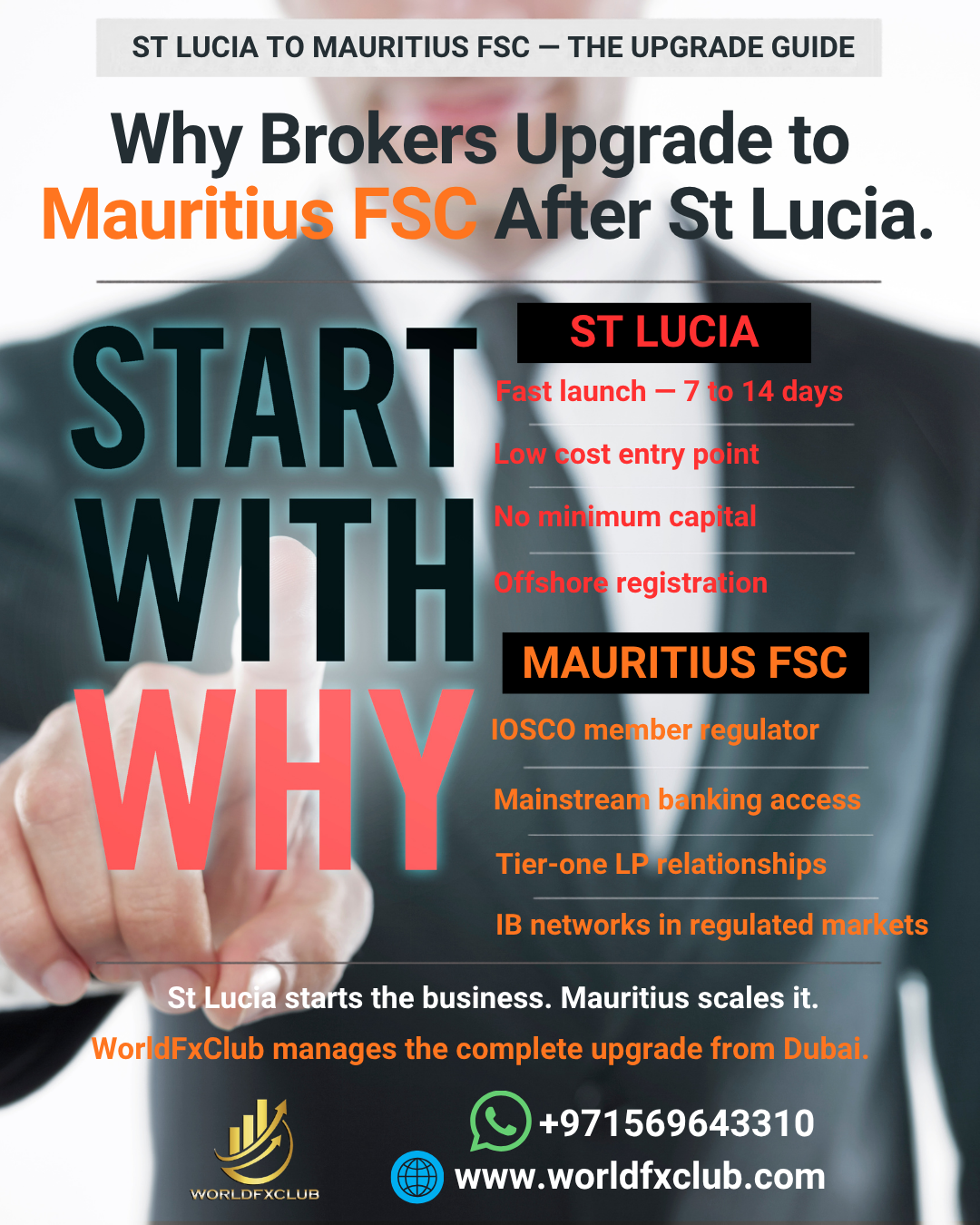
The St Lucia IBC is the most popular starting point for offshore forex broker setup in 2026. It incorporates fast, costs less than almost any comparable offshore structure and requires no minimum capital. Furthermore, it requires no local office and no residency requirement. It gives every new broker founder access to MT4 and MT5 through MetaQuotes licensing from day one.
However, the St Lucia IBC is a starting point — not a destination. Consequently, a significant proportion of WorldFxClub’s broker clients who launch on a St Lucia structure return within twelve to twenty-four months asking the same question.
What is the next step?
For most of them, the answer is a Mauritius FSC Investment Dealer license. This is the most commercially significant regulatory upgrade available to an offshore STP broker in the retail forex market in 2026.
This blog explains exactly why forex brokers upgrade from St Lucia to a Mauritius forex broker license — the commercial triggers, the operational benefits, the banking advantages and the credibility gains that make the Mauritius FSC the natural next step for every broker that has validated its business model under a St Lucia structure.
What Is a Mauritius FSC Investment Dealer License
The Mauritius Financial Services Commission
The Financial Services Commission of Mauritius — the FSC — is the integrated regulator for the non-banking financial services sector in Mauritius. Furthermore, it is a full member of the International Organisation of Securities Commissions — IOSCO. This places it in the same international regulatory tier as regulators in the UK, Australia, Singapore and Cyprus.
The FSC issues the Investment Dealer license — the license category that covers retail forex and CFD brokerage operations. Furthermore, the Investment Dealer license is a genuine financial services regulatory license. It is not an offshore business registration. Consequently, it carries a materially different level of credibility than a St Lucia IBC registration. Banking access and commercial legitimacy are both significantly stronger under a Mauritius FSC structure.
The Investment Dealer License — What It Covers
The Mauritius FSC Investment Dealer license authorises the holder to deal in securities as principal or agent — covering forex, CFDs, equities, commodities and other financial instruments. Furthermore, the license is issued under the Securities Act 2005 and the Securities Licensing Rules 2007. Consequently, it is a fully regulated license operating under a statutory framework that meets international standards for financial services regulation.
The St Lucia Starting Point — Why It Works
What St Lucia Gets Right for New Brokers
Before understanding why brokers upgrade to a Mauritius forex broker license, it is important to understand why St Lucia is the right starting point. Starting there rather than attempting to obtain a Mauritius FSC license from day one is the strategically correct approach for most new broker founders.
Speed. A St Lucia IBC incorporates in 7 to 14 days. The Mauritius FSC licensing process takes significantly longer — typically four to six months from application to license grant. Furthermore, a new broker founder who is ready to launch immediately cannot wait six months. Consequently, St Lucia gets the broker live and generating spread revenue while the Mauritius application is in progress.
Cost. The St Lucia IBC incorporation costs significantly less than the Mauritius FSC application and ongoing compliance costs. Furthermore, a new broker that has not yet validated its business model should not commit significant capital to regulatory costs. Prove the model first. Consequently, St Lucia allows every founder to test the business model at low cost before making the larger capital commitment of a Mauritius FSC license.
Minimum capital. The St Lucia IBC requires no minimum capital from the regulatory side. Furthermore, the Mauritius FSC Investment Dealer license requires a minimum stated capital. This creates a capital commitment that is appropriate for a validated business but premature for an unvalidated one. Consequently, founders who start with St Lucia preserve capital for operations and client acquisition during the critical first year.
MetaQuotes access. A St Lucia IBC is eligible for MetaQuotes licensing — giving access to MT4 and MT5 from day one. Furthermore, the Mauritius FSC licensed entity is also eligible for MetaQuotes licensing. Consequently, the trading platform infrastructure does not need to be rebuilt during the regulatory upgrade. It carries forward from St Lucia to Mauritius seamlessly.
What St Lucia Cannot Do
St Lucia is an offshore business registration — not a regulated financial services license. This distinction matters commercially in several specific ways that become increasingly significant as a broker grows.
Banking access. A St Lucia IBC has limited access to mainstream banking partners. Furthermore, EMI accounts and PSP relationships available to a St Lucia IBC typically carry higher fees and lower limits. The terms are also more restrictive than those available to a Mauritius FSC licensed entity. Consequently, as the broker’s deposit and withdrawal volumes grow, the payment infrastructure limitations of a St Lucia IBC become an increasingly significant operational constraint.
Client credibility. Sophisticated retail traders — particularly those in regulated markets such as the UAE, UK, Europe and Australia — are increasingly aware of the difference between an offshore registered broker and a regulated one. Furthermore, they are increasingly likely to ask about regulatory status before funding a trading account. Consequently, a broker operating under a St Lucia IBC will lose clients to regulated competitors as its target market matures.
Further Limitations of the St Lucia Structure
Partnership access. Large liquidity providers, prime brokers and institutional banking partners routinely require evidence of regulatory status before entering into commercial relationships. Furthermore, the best LP pricing and the most favourable prime brokerage terms are typically reserved for regulated entities. Consequently, a St Lucia IBC broker may find itself locked out of the LP relationships it needs to remain competitive as the client base grows.
IB and affiliate recruitment. Professional IBs and affiliate networks — particularly those operating in regulated markets — increasingly require their broker partners to hold a recognised financial services license. Furthermore, the most commercially productive IB relationships are with IBs who have their own compliance obligations. These IBs prioritise regulated broker partners above all else. Consequently, a St Lucia IBC broker faces an increasingly significant IB recruitment disadvantage as it attempts to scale its partner network.
The Triggers — Why Brokers Upgrade When They Do
The Commercial Moments That Drive the Decision
Most broker founders do not wake up one day and decide to upgrade to a Mauritius forex broker license out of ambition alone. The decision is almost always triggered by one or more specific commercial moments — situations where the St Lucia structure creates a problem that the Mauritius FSC license would solve.
Trigger 1 — Banking Friction
The most common trigger for the Mauritius FSC upgrade is banking friction. A broker that is growing — more clients, more deposits, more withdrawals — begins to encounter the limitations of the banking and payment infrastructure available to a St Lucia IBC entity.
EMI accounts that worked adequately for the first 100 clients begin to impose volume limits and higher fees. Additional compliance requirements also emerge as transaction volumes increase. Furthermore, the payment channels available to a St Lucia IBC are typically narrower than those available to a regulated entity. Consequently, the growing broker finds itself turning away client deposits or delaying withdrawals — not because of operational failures but because of structural limitations in its banking infrastructure.
A Mauritius FSC licensed entity opens access to a materially different tier of banking relationships. Furthermore, mainstream banks and tier-one payment processors that decline to work with offshore registered entities will often approve applications from Mauritius FSC licensed entities. Institutional banking partners follow the same pattern. Consequently, the regulatory upgrade solves the banking problem directly — expanding the payment infrastructure available to the broker without requiring any change to the underlying business model or technology stack.
Trigger 2 — Client Demands
The second most common trigger is client demand for regulatory credentials. As a broker’s client base grows and matures — and as its reputation spreads beyond the founder’s immediate community into wider trading networks — a growing proportion of prospective clients ask about regulation before funding an account.
This question — “are you regulated?” — is not a threat to the business. It is a commercial signal that the broker has reached the audience maturity level where a Mauritius forex broker license creates a meaningful competitive advantage. Furthermore, sophisticated traders who ask about regulation are typically higher-value clients. They trade larger volumes, stay loyal longer and refer more peers than casual traders. Consequently, obtaining a Mauritius FSC license converts a client acquisition barrier into a client acquisition advantage.
Further Commercial Triggers for the FSC Upgrade
Trigger 3 — LP and Prime Brokerage Access
As a broker’s trading volumes grow, the quality of its LP relationships becomes an increasingly significant competitive factor. Furthermore, the raw spread quality, execution speed and margin terms from tier-one LPs are substantially better. Retail-facing LPs cannot match this quality. Tier-one LPs and prime brokers typically require regulatory status as a prerequisite for their institutional pricing tiers. Furthermore, some will work with offshore entities on a case-by-case basis. However, they reserve their best pricing and terms for regulated counterparties. Consequently, the Mauritius FSC license unlocks LP and prime brokerage relationships that improve the broker’s spread competitiveness — directly benefiting every client on the platform.
Trigger 4 — IB Network Scaling
A growing IB network increasingly includes IBs who operate in regulated markets — the UAE, UK, Europe, Australia and South Africa. These IBs have their own compliance obligations that create a preference or requirement for regulated broker partners. Furthermore, the most commercially productive IBs are typically those with established trading communities in these markets. Consequently, a broker that cannot demonstrate regulatory status to prospective IBs in regulated markets faces a significant IB recruitment ceiling.
The Mauritius FSC license removes this ceiling. Furthermore, it signals to every professional IB that the broker operates under a recognised regulatory framework. This meets the minimum credibility threshold that most professional IBs apply when evaluating broker partnerships. Consequently, the regulatory upgrade directly expands the addressable IB partner market for every broker that makes the transition.
Trigger 5 — Brand and Reputation Building
Some brokers upgrade to a Mauritius forex broker license not because of a specific operational trigger but because they are building toward a specific long-term brand position. A regulated, credible, institutional-grade broker rather than an offshore retail platform is a legitimate and commercially sound strategic rationale. Furthermore, the broker that obtains a Mauritius FSC license while its competitors remain on offshore registrations builds a durable competitive advantage. This advantage compounds over time. Consequently, early regulatory investment — at the point where it is affordable but before it is urgent — is often the most commercially intelligent timing for the upgrade.
What the Mauritius FSC License Delivers — The Specific Benefits
Banking and Payment Infrastructure
The most immediately impactful benefit of the Mauritius FSC license for most upgrading brokers is access to a materially better banking and payment infrastructure.
Mainstream banks — including tier-two and tier-three banks in multiple jurisdictions — decline to open accounts for offshore registered entities. They will however consider applications from Mauritius FSC licensed entities. Furthermore, these banking relationships typically come with lower transaction fees and higher volume limits. The terms are also more favourable than the EMI accounts available to St Lucia IBC entities. Consequently, the cost of processing client deposits and withdrawals typically decreases significantly after the Mauritius FSC upgrade — improving margins while simultaneously improving the client experience.
Payment processors that offer local payment methods in markets such as South Africa, Kenya, India and Southeast Asia typically require regulatory status for their institutional-tier integrations. These include local bank transfers, card processing and mobile money integrations. Furthermore, local payment methods dramatically improve deposit conversion rates in markets where international card payments are inconvenient or expensive. Consequently, the Mauritius FSC license opens payment channel opportunities that directly improve the commercial performance of the broker in key target markets.
Client Credibility and Conversion
A Mauritius FSC licensed broker can display its regulatory credentials — the FSC license number and the FSC website verification link — on every client-facing communication. Furthermore, the FSC maintains a public register of licensed entities that any prospective client can verify independently. Consequently, the regulatory credentials are verifiable and therefore credible — unlike offshore business registration numbers that carry no comparable verification value.
This credibility translates directly into client acquisition. Furthermore, prospective clients who research the broker before funding an account and find FSC licensing details are significantly more likely to complete their registration and deposit. Consequently, the regulatory upgrade improves client acquisition conversion rates — particularly for the higher-value client segments that conduct due diligence before depositing.
Further Benefits of the Mauritius FSC License
LP and Prime Brokerage Relationships
The Mauritius FSC license opens access to LP and prime brokerage relationships that are unavailable or restricted for offshore registered entities. Furthermore, better LP relationships mean tighter raw spreads, faster execution and higher leverage terms. All of these improve the broker’s product competitiveness in the retail market. Consequently, the LP quality improvement that typically follows a Mauritius FSC upgrade benefits every client on the platform — creating a direct commercial justification for the regulatory investment from the client’s perspective.
IOSCO Membership Credibility
Mauritius is an IOSCO member — the International Organisation of Securities Commissions. This places it in the same international regulatory tier as the UK, Australia, Singapore and Cyprus. Furthermore, IOSCO membership means that the Mauritius FSC is a peer of the FCA, ASIC, MAS and CySEC. International banking and institutional counterparties recognise this equivalence. Consequently, a Mauritius FSC licensed entity has access to institutional credibility that no offshore registration can replicate.
The Foundation for Further Regulatory Development
For many brokers, the Mauritius FSC license is not the final regulatory destination — it is the second step in a deliberate regulatory development pathway. Furthermore, operating under a Mauritius FSC license for two to three years builds the track record and compliance infrastructure needed for higher-tier licenses. Institutional relationships develop in parallel. These include ADGM, DFSA, CySEC or FCA — when the business volume and strategic ambition justify the investment. Consequently, the Mauritius FSC upgrade is not just a current commercial decision. It is a foundation for the entire long-term regulatory trajectory of the business.
The Upgrade Process — What the Transition Involves
From St Lucia to Mauritius — The Practical Steps
The transition from a St Lucia IBC to a Mauritius FSC licensed structure is a managed process — not a replacement of the existing business. Furthermore, the St Lucia IBC typically continues to operate during the Mauritius FSC application process. Consequently, the broker generates no gap in revenue or client service during the regulatory transition.
Step 1 — Corporate structure planning.
The Mauritius FSC licensed entity is typically a new Mauritius company — a Global Business Company — established alongside the existing St Lucia IBC. Furthermore, WorldFxClub advises on the optimal corporate structure for each specific broker. This includes how to manage the transition of client relationships, LP agreements and banking from the St Lucia entity to the Mauritius entity. Consequently, the structural planning phase determines the timeline, cost and commercial impact of the entire regulatory transition.
Step 2 — Mauritius GBC incorporation.
The Mauritius Global Business Company — GBC — is the corporate entity that holds the FSC Investment Dealer license. Furthermore, incorporation of the GBC is a prerequisite for the FSC license application. The FSC licenses the company, not the individual founder. Consequently, the GBC must be incorporated and fully compliant before the FSC application is submitted.
Step 3 — FSC Investment Dealer license application.
The FSC application requires a comprehensive documentation package — business plan, compliance manuals, KYC and AML policies, financial projections, director and shareholder due diligence documentation and evidence of adequate capitalisation. Furthermore, the FSC reviews every application carefully. It may request additional documentation or clarification during the review process. Consequently, the quality and completeness of the initial application package significantly affects both the approval probability and the processing timeline.
Step 4 — Compliance infrastructure build.
A Mauritius FSC licensed entity must operate with a fully functional compliance infrastructure — a compliance officer, compliance policies and procedures, ongoing AML monitoring, transaction reporting and regulatory filing obligations. Furthermore, this compliance infrastructure must be in place and operational at the point of license grant. Consequently, WorldFxClub advises on compliance infrastructure build for every FSC license applicant. This ensures the operational compliance framework matches the regulatory requirements from day one.
Step 5 — Banking and LP transition.
Once the FSC license is granted, the broker transitions its banking relationships and LP agreements from the St Lucia entity to the Mauritius entity. Furthermore, WorldFxClub manages this transition process — coordinating with banking partners, EMI providers and LPs to ensure the transition is commercially seamless. Consequently, the client experience during the transition is unaffected. Deposits, withdrawals and trading continue without interruption.
What WorldFxClub Manages — The Complete Advisory Package
The Full Upgrade Service From Dubai
WorldFxClub advises on the complete St Lucia to Mauritius FSC upgrade process from our Dubai base — from initial structural planning through to FSC license grant and post-license compliance management.
Structural planning and corporate advice — WorldFxClub advises on the optimal corporate structure for each specific broker. This includes GBC incorporation in Mauritius and the relationship between the St Lucia and Mauritius entities during the transition.
FSC license application preparation — WorldFxClub prepares the complete FSC application documentation package — business plan, compliance manuals, KYC and AML policies, financial projections and director due diligence. Furthermore, our team manages the FSC application process from submission through to license grant. This includes responding to FSC queries and requests for additional documentation.
Further Services WorldFxClub Manages
Compliance infrastructure advisory — WorldFxClub advises on the build of the compliance infrastructure required for FSC license operation. This covers compliance officer appointment, compliance policies and procedures, ongoing AML monitoring systems and regulatory filing obligations.
Banking and LP transition management — WorldFxClub coordinates the transition of banking relationships and LP agreements from the St Lucia entity to the Mauritius entity. Furthermore, our team introduces every FSC license holder to banking partners and LPs appropriate for their specific client profile and trading volume.
Ongoing FSC compliance management — WorldFxClub provides ongoing compliance management for every FSC license holder — annual regulatory filings, compliance audits, policy updates and regulatory correspondence management. Consequently, every WorldFxClub FSC license holder operates with the ongoing compliance support needed to maintain their license in good standing throughout the business lifecycle.
Frequently Asked Questions
Can a St Lucia IBC Broker Apply for a Mauritius FSC License Directly?
The Mauritius FSC Investment Dealer license is issued to a Mauritius Global Business Company — not to a St Lucia IBC. Furthermore, a new GBC must be incorporated in Mauritius before the FSC license application is submitted. Consequently, the upgrade process involves establishing a new Mauritius entity rather than converting the existing St Lucia entity. Both can operate simultaneously during the transition period.
How Long Does the Mauritius FSC License Application Take?
The FSC Investment Dealer license application process typically takes four to six months from submission to license grant. This depends on the completeness of the application documentation and the FSC’s current processing workload. Furthermore, WorldFxClub prepares every application package to the highest standard. This minimises the risk of delays caused by incomplete or inadequate documentation. Consequently, every WorldFxClub FSC application client starts the process with a clear timeline and realistic expectations.
Does the St Lucia IBC Close When the Mauritius FSC License Is Obtained?
Not necessarily. Many brokers maintain both entities during the transition period — operating new client onboarding through the Mauritius entity while managing the wind-down of the St Lucia entity over an agreed timeline. Furthermore, WorldFxClub advises on the optimal transition timeline for each specific broker. This balances commercial continuity with the costs of maintaining two entities simultaneously. Consequently, the decision to close the St Lucia entity is made based on each broker’s specific client relationships, LP agreements and banking arrangements.
What Are the Ongoing Compliance Obligations of a Mauritius FSC License?
A Mauritius FSC Investment Dealer license carries ongoing compliance obligations — annual regulatory filings, compliance audits, AML reporting, transaction monitoring and maintaining a compliance officer. Furthermore, the FSC conducts periodic supervisory reviews of licensed entities. It expects evidence of ongoing compliance with all applicable regulations. Consequently, WorldFxClub provides ongoing compliance management for every FSC license holder as a standard post-license advisory service.
Is the Mauritius FSC License the Right Next Step for Every St Lucia Broker?
The Mauritius FSC license is the right next step for brokers that have validated their business model — reached a client base and trading volume that justifies the regulatory investment — and are experiencing one or more of the commercial triggers discussed in this blog. Furthermore, it is not the right step for a broker that has just launched or has not yet reached operational self-sustainability. Consequently, WorldFxClub advises every broker client on the right timing for the Mauritius FSC upgrade based on their specific commercial situation — during the free consultation.
WhatsApp WorldFxClub — Upgrade Your Broker to a Mauritius FSC License
The Mauritius forex broker license is the most commercially significant regulatory upgrade available to a St Lucia IBC broker that has validated its business model. Furthermore, it opens banking relationships, LP partnerships, IB networks and client segments that are unavailable or severely restricted under an offshore registration structure.
WorldFxClub advises on the complete St Lucia to Mauritius FSC upgrade process from our Dubai base — structural planning, GBC incorporation, FSC application preparation, compliance infrastructure build and ongoing post-license compliance management.
Contact WorldFxClub via WhatsApp for a free upgrade consultation today: