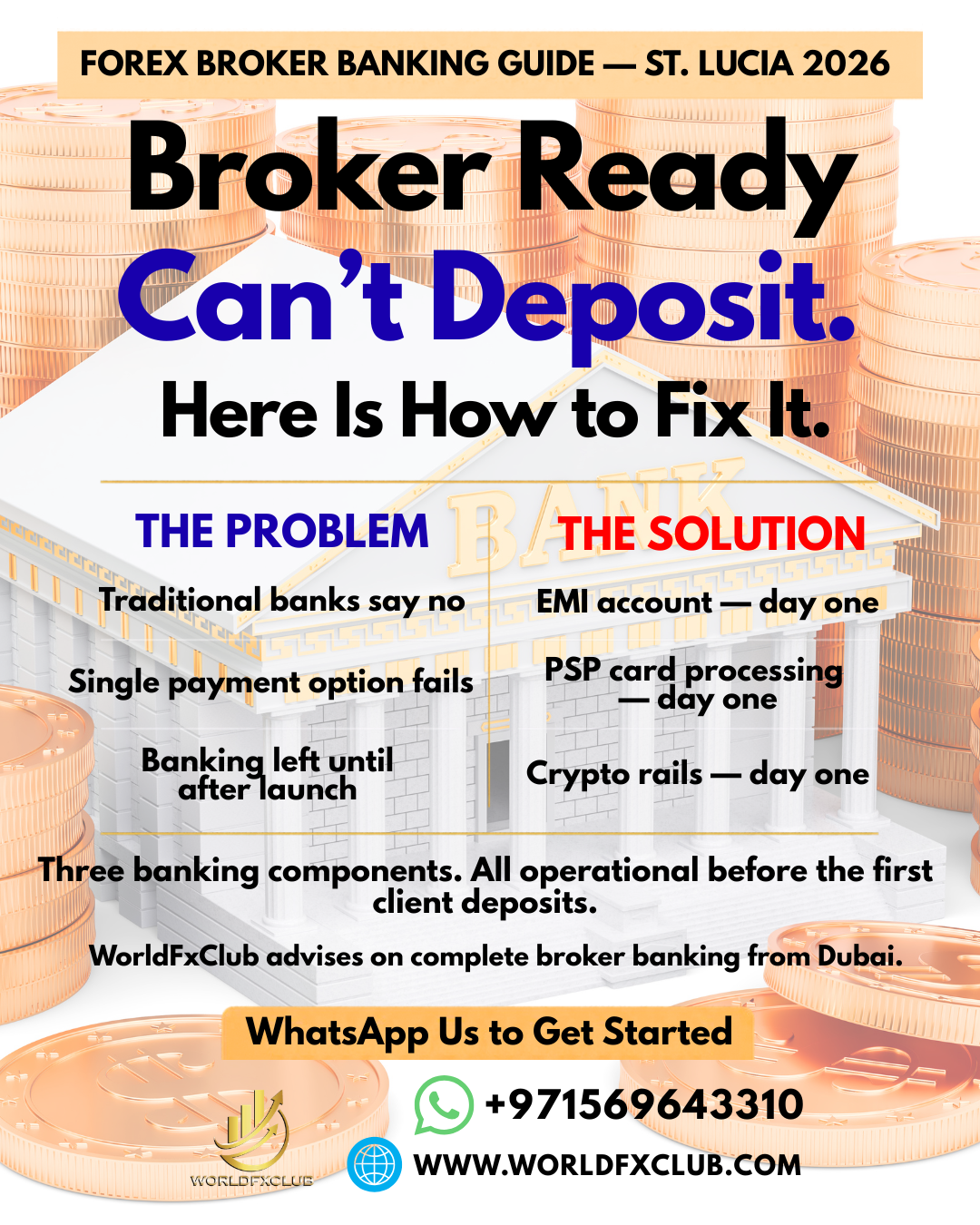
St Lucia forex broker banking is one of the most practically challenging and most commercially critical elements of any offshore broker setup — and it is the one that most new broker founders underestimate before they launch.
The trading platform can be configured in weeks. The corporate entity incorporates in 7 to 14 days. The liquidity provider connection can be established through WorldFxClub’s advisory process. However, banking — the payment infrastructure that allows the broker to accept client deposits and process client withdrawals — is the operational foundation that determines whether the broker can actually function as a business from day one.
Furthermore, St Lucia forex broker banking operates in a specific regulatory and commercial environment that is materially different from the banking environment available to domestically regulated brokers. Consequently, every new broker founder who understands this environment before they launch is significantly better positioned than one who discovers its challenges after their first client tries to make a deposit.
This blog covers everything a new St Lucia forex broker founder needs to know about banking — the options available, the challenges to expect, the solutions that work and how WorldFxClub advises every broker client on building a payment infrastructure that supports growth from day one.
Why St Lucia Forex Broker Banking Is Different
The Offshore Banking Reality
A St Lucia IBC is an offshore corporate entity — not a domestically regulated financial services provider. This distinction has direct and significant implications for banking access. Furthermore, traditional high-street banks apply a standard policy of declining to open business accounts for offshore-registered financial services entities. This affects every major retail and commercial bank across most jurisdictions. Consequently, the traditional banking route that most non-financial businesses use is effectively closed to a St Lucia IBC forex broker.
This is not a St Lucia-specific problem. It affects every offshore broker structure — Seychelles, Vanuatu, Belize and others face the same banking environment. Furthermore, it is not a permanent barrier. It is a structural characteristic of the offshore broker banking landscape that requires a different approach. This approach is built around payment infrastructure options specifically designed for offshore financial services entities. Consequently, understanding these options before launch is the most important banking preparation step every new broker founder can take.
The Covering Account Requirement
Every STP forex broker must maintain a covering account — a funded account held with the liquidity provider that covers the broker’s margin obligations on client positions. Furthermore, the broker holds this account directly with the LP and uses it to cover the leverage gap between LP leverage and the retail leverage the broker offers to clients.
The covering account is not a banking product — it is an LP requirement. Consequently, WorldFxClub manages it entirely through the LP relationship established for every broker client. However, it does require the broker to maintain adequate capital. This capital must be transferred from the broker’s operational banking infrastructure to the LP. Consequently, the quality and efficiency of the broker’s operational banking directly affects the speed and reliability of covering account management.
The Payment Infrastructure Options for St Lucia Forex Brokers
Option 1 — Electronic Money Institutions (EMIs)
EMIs — Electronic Money Institutions — are the primary banking solution for most St Lucia forex brokers in 2026. Furthermore, they are regulated financial technology companies that hold e-money licenses from reputable financial regulators — typically in the UK, EU or other tier-one jurisdictions. Consequently, they operate in a regulatory framework that is credible and compliant. This framework is specifically open to offshore financial services entities that traditional banks decline.
EMIs provide multi-currency business accounts, IBAN numbers, SWIFT transfers, SEPA transfers and card processing in a single platform. Furthermore, they offer onboarding processes specifically designed for offshore financial services businesses. These include forex brokers, crypto platforms and other fintech entities that traditional banks routinely decline. Consequently, EMIs are the most accessible and most practical first banking solution for every new St Lucia forex broker.
Key EMI advantages for St Lucia forex brokers:
Fast onboarding — most EMIs clearly define the documentation requirements upfront — making it possible to prepare a complete and compliant application package before submission. Furthermore, a well-prepared EMI application delivers a live account within weeks of starting the broker setup process. Consequently, early EMI application preparation is one of the most commercially valuable pre-launch activities every broker founder can undertake.
Multi-currency capability — most EMIs support USD, EUR, GBP and a range of additional currencies in a single account. Furthermore, multi-currency capability is essential for a forex broker serving clients across multiple geographic markets. Consequently, an EMI with strong multi-currency support provides the payment infrastructure foundation most brokers need. This is a non-negotiable requirement from day one.
SEPA and SWIFT transfers — EMI accounts typically support both SEPA transfers for EU-based clients and SWIFT transfers for international clients. Furthermore, ensuring the chosen EMI supports both SEPA and SWIFT is a non-negotiable requirement. Any broker with a geographically diverse client base needs both. Consequently, SWIFT capability is essential for any broker serving clients outside the SEPA zone — particularly in the Middle East, Asia and Africa.
Card processing — many EMIs offer integrated card processing — allowing clients to deposit via Visa and Mastercard directly through the broker’s client portal. Furthermore, card processing is one of the most important deposit methods for retail forex clients. Consequently, card processing capability is a significant competitive advantage for any broker that can offer it from day one.
Key EMI Limitations to Manage
Volume limits — EMI accounts typically carry monthly transaction volume limits that may become restrictive as the broker grows. Furthermore, the broker can negotiate these limits upward as it demonstrates transaction history and compliance quality. Consequently, selecting an EMI with a clear volume limit upgrade pathway is an important factor. This must be evaluated during the initial EMI selection process.
Higher fees — EMI transaction fees are typically higher than those charged by traditional banks. Furthermore, these fees apply to every deposit and withdrawal — directly affecting the broker’s operational cost structure. Consequently, EMI fee structures must be factored into the broker’s financial model before selection — not after the account is live.
Account restrictions — EMIs do not always clearly communicate restrictions on transaction types, geographic markets or client profiles during the onboarding process. Furthermore, these restrictions vary significantly between EMI providers. Consequently, WorldFxClub advises every broker client on the specific EMI restrictions relevant to their target market and client profile. This advisory happens before any EMI application is submitted.
Option 2 — Payment Service Providers (PSPs)
PSPs — Payment Service Providers — are specialist payment processing companies that provide deposit and withdrawal infrastructure specifically for high-risk merchant categories — including forex brokers. Furthermore, PSPs typically offer card processing, alternative payment methods and sometimes bank transfer capabilities packaged as a single integrated payment solution. Consequently, they complement EMI accounts rather than replacing them. They provide payment method coverage that the EMI alone may not offer.
Key PSP advantages for St Lucia forex brokers:
Card processing for high-risk merchants — most mainstream card processors decline to process payments for forex broker accounts classified as high-risk. Furthermore, specialist PSPs that focus on the forex and CFD sector have established acquiring relationships. These relationships support forex broker card processing specifically. Consequently, a PSP with forex broker experience is the most reliable route to card processing capability for a new St Lucia IBC broker.
Alternative payment methods — leading PSPs in the forex space offer a range of alternative payment methods beyond bank transfers and cards — including e-wallets, local payment methods and increasingly crypto payment rails. Furthermore, local payment methods are particularly important for brokers serving clients in certain markets. These are markets where international card processing is expensive or unreliable. Consequently, PSPs with strong local payment method coverage in the broker’s target markets can significantly improve deposit conversion rates.
Integrated client portal — most PSPs offer APIs that integrate directly into the broker’s client portal — allowing deposits and withdrawals to be processed automatically without manual intervention. Furthermore, automated payment processing is essential for any broker that wants to scale beyond a handful of active clients. Consequently, PSP API integration capability is a non-negotiable technical requirement for every broker’s payment infrastructure.
Key PSP Limitations to Manage
Rolling reserves — many PSPs require forex brokers to maintain a rolling reserve — a percentage of each transaction held back for a defined period as security against chargebacks and disputes. Furthermore, rolling reserves directly reduce the broker’s available working capital. Consequently, the rolling reserve terms must be clearly understood before any PSP agreement is signed. The broker must factor these into capital planning from the outset.
Chargeback management — forex broker accounts typically attract higher chargeback rates than standard merchant categories. Furthermore, excessive chargebacks can result in PSP account termination without notice — one of the most disruptive operational events a forex broker can experience. Consequently, proactive chargeback management is an operational priority for every broker from day one. This includes clear deposit confirmations, transparent terms and conditions and responsive client support.
Option 3 — Crypto Payment Rails
Crypto payment rails — accepting client deposits and processing client withdrawals in USDT, BTC, ETH and other cryptocurrencies — are an increasingly important component of the payment infrastructure for St Lucia forex brokers in 2026. Furthermore, crypto payment processing bypasses many of the traditional banking limitations that affect offshore broker payment infrastructure. Consequently, crypto rails provide a fast low-cost and globally accessible payment option that complements EMI and PSP infrastructure rather than replacing it.
Key crypto payment advantages for St Lucia forex brokers:
No geographic restrictions — crypto payments work across every jurisdiction without the geographic restrictions that affect card processing and bank transfers in many markets. Furthermore, clients in markets where traditional payment methods are expensive or unreliable can use crypto deposits as an efficient alternative. This expands the broker’s accessible market significantly. Consequently, crypto payment capability is particularly valuable for brokers serving clients in Africa, Southeast Asia, South Asia and other markets where traditional banking access is limited.
Fast settlement — crypto transactions settle significantly faster than bank transfers — often within minutes rather than hours or days. Furthermore, fast settlement improves the client deposit experience — particularly for clients who want to respond quickly to market opportunities. Consequently, crypto payment processing capability is a meaningful client experience advantage for any broker that offers it.
Lower transaction costs — crypto payment processing typically carries lower per-transaction fees than card processing or international bank transfers. Furthermore, lower payment costs improve the broker’s operational margin — particularly at higher transaction volumes. Consequently, crypto payment rails become increasingly commercially attractive as the broker’s transaction volumes grow.
Key Crypto Payment Limitations to Manage
Volatility risk — crypto assets can depreciate significantly in the time between client deposit and broker conversion to fiat currency. Furthermore, this volatility creates balance sheet risk that the broker must manage actively. Consequently, using stablecoins — USDT, USDC — for broker crypto payment processing minimises volatility risk while retaining the speed and accessibility advantages of crypto payment rails.
Regulatory sensitivity — the regulatory treatment of crypto payments for forex broker accounts varies significantly across jurisdictions. Furthermore, some target markets have specific restrictions on the use of crypto for financial services payments. Consequently, WorldFxClub advises every broker client on the applicable regulatory considerations for crypto payment processing. This advisory covers every specific target market before any crypto payment infrastructure is established.
Option 4 — Offshore Bank Accounts
Offshore bank accounts — accounts held with banks in offshore financial centres including Mauritius, Seychelles, Belize, St Vincent and others — remain an option for some St Lucia forex brokers. Furthermore, offshore banks in these jurisdictions have historically been more open to forex broker accounts than high-street banks in major jurisdictions. Consequently, they represent an alternative banking route for brokers that cannot access EMI or PSP infrastructure in their preferred jurisdictions.
Managing Offshore Bank Account Risk
However, offshore bank accounts carry their own limitations and risks that the broker must carefully manage. Furthermore, the quality, stability and reputation of offshore banks vary significantly. Some offshore banking jurisdictions have faced increased international scrutiny that has affected the usability of accounts held there. Consequently, WorldFxClub advises on the specific offshore banking options appropriate for each broker’s situation during the initial consultation — rather than recommending a one-size-fits-all offshore banking approach.
Building a Payment Infrastructure Stack — The Practical Approach
Why a Single Payment Option Is Never Enough
The most common payment infrastructure mistake made by new St Lucia forex brokers is launching with a single payment option — typically one EMI account — and assuming it will be sufficient for all their needs. Furthermore, a single payment option creates operational dependency that becomes a critical business risk. This risk materialises the moment that payment option faces any limitation, restriction or technical problem. Consequently, building a diversified payment infrastructure stack is the most important payment infrastructure principle for every new broker. This means multiple options covering different payment methods, client geographies and backup scenarios.
The Recommended Payment Infrastructure Stack
WorldFxClub recommends that every new St Lucia forex broker builds a payment infrastructure stack with at least three components operational before onboarding the first client.
Component 1 — Primary EMI account.
The primary EMI account provides the broker’s main operational banking — business account, IBAN, SWIFT and SEPA transfers. Furthermore, it serves as the primary deposit and withdrawal channel for bank transfer clients. Consequently, selecting the right primary EMI — one with strong multi-currency support, competitive fees and a clear volume limit upgrade pathway — is the single most important payment infrastructure decision every new broker makes.
Further Components of the Payment Stack
Component 2 — PSP for card processing.
The PSP provides card processing capability — allowing clients to deposit via Visa and Mastercard directly through the client portal. Furthermore, card processing capability is essential for any broker serving retail clients in markets where bank transfers are inconvenient. Consequently, establishing PSP card processing before launch rather than after is a non-negotiable element of the payment infrastructure stack for any retail-facing broker.
Component 3 — Crypto payment rails.
Crypto payment processing — particularly USDT deposits and withdrawals — provides a fast low-cost globally accessible payment option that complements the EMI and PSP infrastructure. Furthermore, crypto rails are particularly important for brokers serving clients in markets where traditional banking is expensive or unreliable. Consequently, integrating crypto payment capability into the client portal before launch significantly expands the broker’s accessible market. This expansion is effective from day one.
The Banking Timeline — When to Start
Banking Setup Must Start at the Same Time as Corporate Incorporation
The single most common and most commercially damaging banking mistake made by new St Lucia forex broker founders is treating banking as a post-incorporation task — something to sort out after the corporate entity is established and the trading platform is configured.
This approach consistently leads to the same outcome. The broker is technically ready to go live — platform configured, LP connected, CRM operational — but cannot accept client deposits because the payment infrastructure is not yet in place. Furthermore, EMI onboarding, PSP application and crypto payment integration all take time — typically several weeks each. Consequently, starting the banking setup at the same time as the corporate incorporation — not after — is the most important timing decision every new broker founder can make.
Why WorldFxClub Starts Banking on Day One
WorldFxClub advises every broker client to begin the banking application process on the same day as the St Lucia IBC incorporation instruction. This ensures the payment infrastructure is operational by the time the platform and CRM are ready. Furthermore, starting the EMI application, PSP onboarding and crypto payment integration simultaneously with the corporate setup removes the most common cause of launch delays for new offshore brokers. Consequently, every WorldFxClub broker client launches with a complete payment infrastructure stack rather than a partially operational one.
What WorldFxClub Manages — The Banking Advisory Service
The Complete Banking Advisory Package
WorldFxClub advises on St Lucia forex broker banking for every broker client. This covers initial payment infrastructure planning through to EMI onboarding, PSP introduction and crypto payment integration.
EMI identification and onboarding advisory — WorldFxClub identifies the most appropriate EMI options for each specific broker based on their target markets, client profile and transaction volume expectations. Furthermore, our team prepares every EMI application package to the highest standard. This minimises the risk of delays caused by incomplete or inadequate documentation. Consequently, every WorldFxClub broker client starts the EMI application process with the highest possible probability of first-time approval.
PSP introduction and onboarding advisory — WorldFxClub introduces every broker client to PSP partners appropriate for their specific situation — including forex-specialist card processors with established acquiring relationships for offshore broker accounts. Furthermore, our team advises on the PSP agreement terms. These include rolling reserve structures, fee schedules and API integration requirements. Consequently, every WorldFxClub broker client enters their PSP relationship with a clear understanding of the commercial and operational terms.
Further Banking Advisory Services
Crypto payment infrastructure advisory — WorldFxClub advises on the setup of crypto payment processing for every broker client — including the choice of crypto payment processor, the integration of crypto deposit and withdrawal functionality into the client portal and the regulatory considerations applicable to each target market. Furthermore, our team advises on the appropriate stablecoin vs crypto asset mix for the broker’s specific client base. Consequently, every WorldFxClub broker client launches crypto payment capability with the right technical and regulatory foundations in place.
Banking transition advisory — as the broker grows and approaches the regulatory upgrade to a Mauritius FSC structure, WorldFxClub advises on the transition of banking relationships from the offshore EMI infrastructure to the mainstream banking relationships that a Mauritius FSC licensed entity can access. Furthermore, this banking transition advisory is integrated into the broader regulatory upgrade process. Consequently, the banking infrastructure improves in line with the regulatory structure. The client deposit and withdrawal experience remains uninterrupted throughout the transition.
Frequently Asked Questions
Can a St Lucia Forex Broker Open a Traditional Bank Account?
Traditional high-street banks in most major jurisdictions decline to open business accounts for offshore-registered financial services entities including St Lucia IBC forex brokers. Furthermore, this is a standard banking policy rather than a St Lucia-specific limitation — the same restriction applies to brokers incorporated in Seychelles, Vanuatu, Belize and other offshore jurisdictions. Consequently, the practical banking solution for St Lucia forex brokers is built around EMI accounts, PSP card processing and crypto payment rails — rather than traditional bank accounts.
How Long Does EMI Onboarding Take for a New Broker?
EMI onboarding timelines vary by institution — typically ranging from one to four weeks for a well-prepared application. Furthermore, the completeness and quality of the application documentation is the single most important factor in the onboarding timeline. Consequently, WorldFxClub prepares every EMI application package to the highest standard. The documentation is complete, compliant and presented in the format each EMI requires. Contact WorldFxClub via WhatsApp for a specific timeline estimate for your situation.
What Documents Does a St Lucia Forex Broker Need for EMI Onboarding?
EMI onboarding documentation requirements vary by institution but typically include the complete St Lucia IBC corporate document kit — certificate of incorporation, memorandum and articles of association, share certificates, director appointment letters and corporate resolutions. Furthermore, most EMIs require KYC documentation for all directors and beneficial owners. This includes passport copies, proof of address and in some cases source of funds documentation. Consequently, WorldFxClub prepares the complete EMI application package for every broker client — ensuring all documentation is compiled correctly before submission.
More Questions About St Lucia Forex Broker Banking
Can a St Lucia Forex Broker Accept Crypto Deposits?
Yes. A St Lucia IBC forex broker can accept crypto deposits — including USDT, BTC, ETH and other cryptocurrencies — subject to the applicable regulations in each target market. Furthermore, crypto payment processing is one of the most commercially significant payment infrastructure developments for offshore forex brokers in 2026. It provides a fast low-cost and globally accessible deposit option. This complements traditional payment channels rather than replacing them. Consequently, WorldFxClub advises every broker client on the appropriate crypto payment infrastructure for their specific situation during the initial consultation.
How Many Payment Options Should a New Broker Launch With?
WorldFxClub recommends that every new St Lucia forex broker launches with a minimum of three payment options. These are a primary EMI account for bank transfers, a PSP for card processing and crypto payment rails for clients in markets where traditional banking is expensive or unreliable. Furthermore, launching with a single payment option creates operational dependency that becomes a critical business risk if that payment option faces any kind of limitation. Consequently, building a diversified payment infrastructure stack before the first client onboards is one of the most important operational decisions a new broker makes.
What Happens to Banking When the Broker Upgrades to Mauritius FSC?
A Mauritius FSC licensed entity has access to a materially better tier of banking relationships than a St Lucia IBC — including mainstream banks, tier-one payment processors and institutional banking partners that decline to work with offshore registered entities. Furthermore, WorldFxClub advises on the banking transition as part of the broader St Lucia to Mauritius FSC regulatory upgrade process. Consequently, the banking infrastructure improves in line with the regulatory structure. The client deposit and withdrawal experience remains uninterrupted throughout the transition.
WhatsApp WorldFxClub — Build Your Broker Banking Infrastructure Today
St Lucia forex broker banking is the operational foundation that determines whether the broker can function as a business from day one. Furthermore, the payment infrastructure decisions made before launch — which EMI to use, which PSP to partner with, whether to integrate crypto payment rails from day one — directly determine the broker’s client experience, deposit conversion rate and operational cost structure.
WorldFxClub advises on the complete St Lucia forex broker banking setup from our Dubai base — EMI identification and onboarding, PSP introduction, crypto payment infrastructure and banking transition advisory as the business grows.
Contact WorldFxClub via WhatsApp for a free broker banking consultation today: