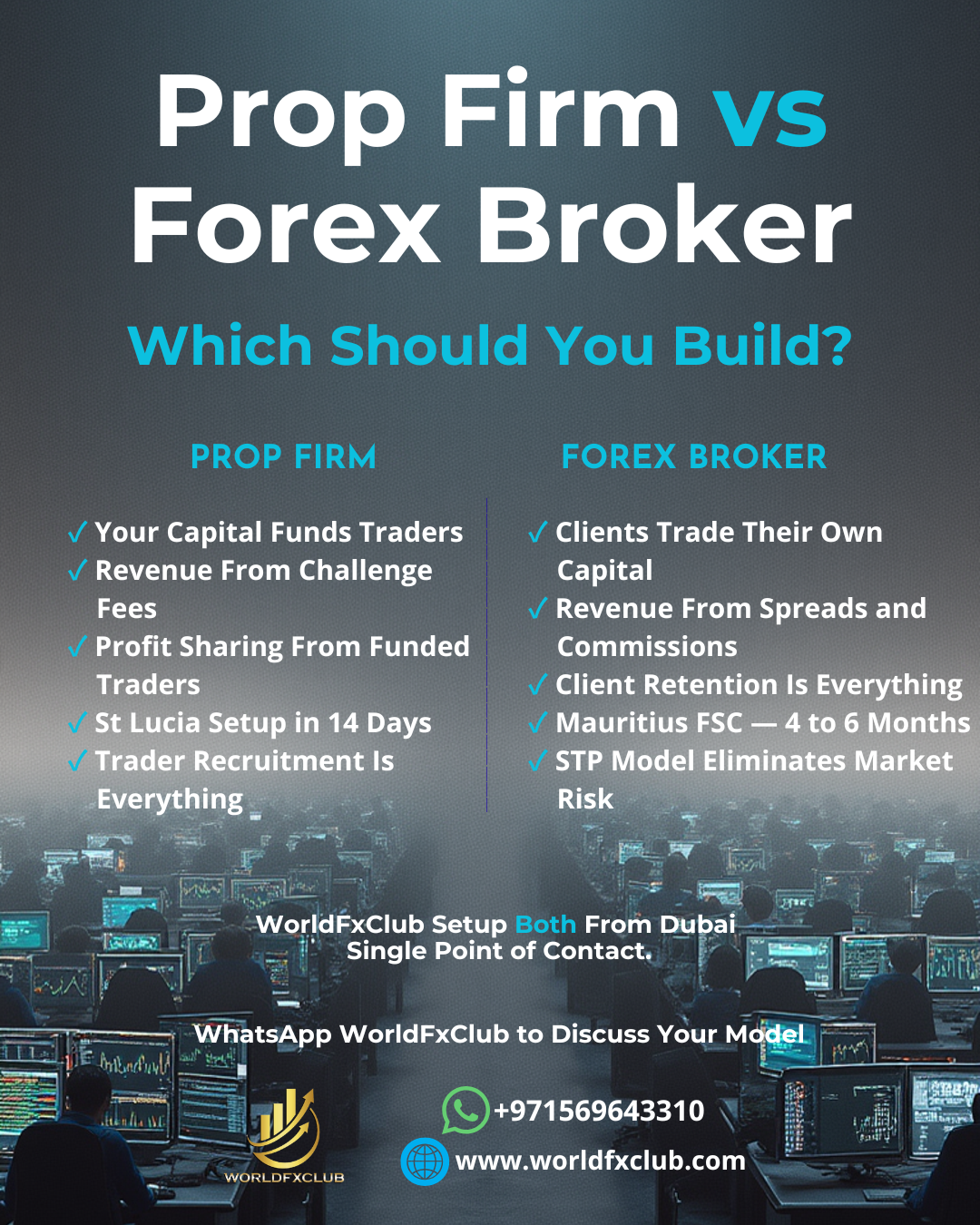
Prop firm vs broker is one of the most common strategic questions WorldFxClub receives from founders across Dubai, the UAE and internationally. Both models operate in the forex and financial markets space. Both have grown significantly over the past several years. Furthermore, both offer compelling business opportunities for the right founder with the right approach.
However, a prop firm and a forex broker are fundamentally different business models. They generate revenue differently, carry different regulatory requirements, attract different types of traders and require different corporate structures, technology infrastructure and operational approaches.
Choosing the wrong model — based on trend rather than strategic fit — is one of the most expensive early mistakes a financial markets entrepreneur can make. This guide explains exactly what a prop firm is, what a forex broker is, how the two models differ across every key factor and how to decide which one is right for your specific situation. WorldFxClub helps founders across Dubai, the UAE and internationally set up both prop firms and forex brokers — across St Lucia, Mauritius FSC and UAE structures — from our Dubai base.
What Is a Prop Firm?
The Definition
A proprietary trading firm — commonly called a prop firm — is a business that deploys its own capital through traders. The prop firm recruits traders through an evaluation or challenge process. Traders who pass the evaluation receive access to the firm’s capital. They then trade with that capital. The firm takes a percentage of any profits the trader generates — typically between 10% and 30% depending on the specific profit-sharing arrangement.
In the modern prop firm model — which has exploded in popularity over the past three to four years — the evaluation itself is a significant revenue source. Traders pay a fee to attempt the evaluation challenge. Many traders attempt multiple challenges before passing — or never pass at all. Consequently, the evaluation fee revenue can be substantial — independent of whether traders are eventually funded and profitable.
How a Prop Firm Makes Money
A prop firm generates revenue from two primary sources:
Source 1 — Evaluation and challenge fees. Traders pay upfront fees to attempt the evaluation challenge. These fees are non-refundable in most prop firm models — regardless of whether the trader passes or fails. For prop firms with high trader volume, evaluation fee revenue can be the primary revenue driver.
Source 2 — Profit sharing from funded traders. Traders who pass the evaluation receive funded accounts. The prop firm takes a percentage of profits generated by these funded traders. Furthermore, the prop firm retains all losses — meaning the firm takes on market risk through its funded traders.
Who Is a Prop Firm Right For?
A prop firm model suits founders who:
- Want to build a business around trader recruitment and evaluation rather than client account management
- Have strong marketing capability to attract large numbers of traders to evaluation programmes
- Are comfortable with the market risk that comes from funding successful traders
- Want a model that can generate significant upfront revenue through evaluation fees
- Are building primarily for the retail trader community who aspire to trade with larger capital than they personally own
What Is a Forex Broker?
The Definition
A forex broker is a business that acts as an intermediary — connecting traders to the forex and CFD market. The broker provides the trading platform, the execution infrastructure and the client account management system. Clients deposit their own funds into segregated accounts. They trade those funds through the broker’s platform. The broker earns revenue through the spreads, commissions or markups applied to those trades.
Unlike a prop firm, a forex broker does not deploy its own capital through its clients. The broker’s clients trade their own money. Consequently, the broker’s primary role is providing the infrastructure through which clients access the market — not funding traders to trade on the firm’s behalf.
How a Forex Broker Makes Money
A forex broker generates revenue from several sources:
Source 1 — Spread markup. The broker marks up the spread between the buy and sell price on every trade. This markup is the broker’s margin on each transaction. In a market maker model, the broker may also profit when clients lose — taking the other side of client trades internally.
Source 2 — Commissions. Some brokers — particularly ECN and STP model brokers — charge a fixed commission per lot traded rather than or in addition to a spread markup.
Source 3 — Swap and overnight fees. Brokers charge swap fees on positions held overnight. These fees represent a significant revenue source for brokers with large volumes of carry-trade clients.
Source 4 — Ancillary fees. Inactivity fees, withdrawal fees, account management fees and other ancillary charges contribute to broker revenue.
Who Is a Forex Broker Right For?
A forex broker model suits founders who:
- Want to build a business around client account management and long-term client relationships
- Have the capital and compliance infrastructure to hold client funds in segregated accounts
- Are comfortable with the regulatory requirements of operating a client-facing financial services business
- Want a recurring revenue model based on client trading activity rather than one-time evaluation fees
- Are building for traders who want to trade their own capital in a regulated or structured environment
Prop Firm vs Broker — The Key Differences
Difference 1 — Whose Capital Is at Risk
This is the most fundamental difference between the two models.
In a prop firm, the firm’s own capital is at risk through funded traders. When a funded trader loses money, the prop firm absorbs those losses. Consequently, the prop firm carries market risk directly — and must manage this risk carefully through position limits, drawdown rules and risk management frameworks applied to funded trader accounts.
In a forex broker, the client’s own capital is at risk. The broker holds client funds in segregated accounts. The broker earns revenue on every trade regardless of whether the client profits or loses — through spreads, commissions and fees. Consequently, the broker’s revenue is more predictable and less directly exposed to individual trader performance.
Difference 2 — Regulatory Requirements
The regulatory requirements for prop firms and forex brokers differ significantly — and this difference has major implications for setup cost, timeline and ongoing compliance obligations.
Forex brokers operating in regulated jurisdictions require a financial services license. A Mauritius FSC Investment Dealer license, for example, requires a GBC company, a Global Business License, a management company substance arrangement, a detailed FSC application and ongoing FSC supervision. The total timeline from GBC incorporation to FSC approval is 4 to 6 months.
Prop firms — in the modern evaluation-based model — typically do not require the same level of financial services regulation as a client-facing forex broker. However, the regulatory landscape for prop firms is evolving rapidly. Consequently, founders who build prop firms without considering the regulatory trajectory risk finding themselves non-compliant as regulators increase their scrutiny of the prop firm model.
WorldFxClub advises every prop firm founder on the current regulatory position and the likely regulatory direction — helping every client structure their prop firm in a way that is sustainable as the regulatory landscape evolves.
Difference 3 — Client Relationship and Retention
A forex broker builds long-term relationships with trading clients. Clients deposit funds, trade over months or years and generate recurring revenue through their ongoing trading activity. Client retention is therefore a critical operational priority for every forex broker. Furthermore, the cost of acquiring a new broker client is typically higher than retaining an existing one — making client lifetime value a key business metric.
A prop firm’s relationship with traders is more transactional. Traders pay evaluation fees, attempt challenges and either pass or fail. Many traders never pass — and their relationship with the prop firm ends when they stop attempting challenges. Consequently, prop firms must continuously acquire new traders to maintain evaluation fee revenue. This makes trader acquisition cost and marketing efficiency critical operational metrics for prop firms.
Difference 4 — Technology Requirements
A forex broker requires a complete technology stack — a trading platform (MT4, MT5 or cTrader), a CRM system, a back office system, payment processing infrastructure and risk management technology. Each component requires setup, integration and ongoing maintenance. The total technology investment for a forex broker is significantly higher than for a prop firm.
A prop firm requires evaluation platform technology, a challenge management system, a funded account management system and payment processing for evaluation fees. Furthermore, prop firms that use a white label trading platform — rather than building their own evaluation technology — can launch with significantly less technology investment than a full forex broker.
Difference 5 — Market Risk Management
A forex broker that operates a market maker model carries internal market risk — taking the other side of client trades. Managing this risk requires sophisticated risk management systems and experienced risk management personnel. Consequently, market maker forex brokers carry significant operational complexity and risk exposure that prop firms do not face in the same way.
A prop firm carries market risk through its funded traders — specifically the risk that funded traders generate losses that the firm must absorb. However, the prop firm manages this risk through strict drawdown rules, position limits and profit targets that define when funded trader accounts are closed. Consequently, prop firm market risk is more controllable than market maker forex broker risk — provided the risk management framework is properly designed and enforced.
Difference 6 — Capital Requirements
Starting a forex broker requires meeting the minimum capital requirements of the chosen jurisdiction’s regulatory authority. For a Mauritius FSC Investment Dealer license, the FSC sets specific minimum capital thresholds. Furthermore, the broker must maintain client funds in segregated accounts — requiring operational capital over and above the regulatory minimum.
Starting a prop firm requires capital to fund the evaluation platform, operational expenses and — most significantly — the funded trader accounts for traders who pass the evaluation. The funded account capital requirement depends on the prop firm’s payout model and the volume of funded traders the firm expects to support. Consequently, the capital requirement for a prop firm scales directly with the firm’s growth — a larger funded trader base requires more capital.
Full Comparison Table — Prop Firm vs Broker
| Factor | Prop Firm | Forex Broker |
| Whose capital is at risk | Firm’s capital — through funded traders | Client’s own capital — in segregated accounts |
| Primary revenue source | Evaluation fees plus profit sharing | Spreads, commissions and fees |
| Revenue predictability | Evaluation fees predictable — funded trader profit sharing variable | More predictable — based on client trading volume |
| Client relationship | Transactional — evaluation based | Long-term — account management based |
| Regulatory requirements | Lighter touch currently — evolving rapidly | Full financial services license required for regulated model |
| Technology requirements | Evaluation platform, challenge management, funded account management | Trading platform, CRM, back office, payment processing |
| Market risk | Funded trader losses absorbed by firm | Market maker risk or passed to liquidity provider |
| Capital requirement | Funded account capital scales with growth | Regulatory minimum plus client fund segregation |
| Setup timeline — offshore | St Lucia LLC — 7 to 14 days | St Lucia LLC — 7 to 14 days |
| Setup timeline — regulated | Varies by jurisdiction and structure | Mauritius FSC — 4 to 6 months |
| Client acquisition focus | Continuous trader recruitment essential | Client acquisition plus retention equally important |
| Ongoing compliance | Annual renewal plus evolving regulation | Full ongoing regulatory compliance programme |
| Profit potential | High — if evaluation volume is strong | High — if client trading volume is strong |
| Risk of loss | Funded trader losses | Market maker losses if applicable |
| WorldFxClub setup support | St Lucia and Mauritius FSC prop firm structures | St Lucia and Mauritius FSC broker structures |
Which Model Is Right for You — The Decision Framework
Question 1 — What Is Your Primary Strength as a Founder?
If your strength is marketing and trader community building — a prop firm may be the better fit. The prop firm model depends heavily on the ability to attract large volumes of traders to evaluation programmes. Founders with strong social media presence, trading community relationships and digital marketing capability are better positioned to build a profitable prop firm than founders without these strengths.
If your strength is client relationship management and financial services operations — a forex broker may be the better fit. The broker model depends on building long-term client relationships, managing client accounts and delivering a consistently high-quality trading experience. Founders with financial services backgrounds and client management experience are better positioned for the broker model.
Question 2 — What Is Your Capital Position?
If you have limited capital and want to launch quickly — a prop firm launched through a St Lucia LLC incorporates in 7 to 14 days at relatively low setup cost. The evaluation fee revenue model can generate income from day one — before any traders are funded. Consequently, the prop firm can be self-funding from an early stage if evaluation volumes are strong.
If you have stronger capital and a longer operational horizon — a forex broker with a Mauritius FSC Investment Dealer license provides a more regulated, banking-credible structure that opens institutional relationships and premium payment processing. However, this requires meeting FSC capital requirements from the outset and sustaining operations through the 4 to 6 month FSC application period.
Question 3 — What Is Your Risk Tolerance?
If you are risk-averse — a forex broker operating on an STP model — passing all client trades to a liquidity provider — eliminates internal market risk almost entirely. The broker earns revenue on every trade regardless of outcome without taking market risk directly.
If you are comfortable with managed risk — a prop firm with a well-designed risk management framework — strict drawdown limits, position size limits and clear funded account termination rules — can control market risk effectively. However, the risk of funded trader losses is inherent in the prop firm model and must be planned for from the outset.
Question 4 — What Is Your Target Market?
If you are targeting aspiring traders who want funded accounts — the prop firm model speaks directly to this market. Aspiring traders with limited capital but strong trading skills are the natural audience for prop firm evaluation programmes.
If you are targeting active retail traders who want to trade their own capital — the forex broker model is the natural fit. These traders want a reliable, regulated platform on which to trade their own funds — not an evaluation challenge with the goal of accessing someone else’s capital.
Question 5 — What Is Your Regulatory Comfort Level?
If you want lighter initial regulatory overhead — a prop firm through a St Lucia LLC provides a fast, cost-effective launch with lighter regulatory obligations than a fully regulated FSC-licensed broker. However, it is important to monitor the evolving regulatory landscape for prop firms — and WorldFxClub advises every prop firm client on regulatory developments that may affect their model.
If you want regulated status and the banking credibility it provides — a forex broker with a Mauritius FSC Investment Dealer license provides the strongest regulatory foundation. Consequently, FSC-licensed brokers access premium banking partners, institutional liquidity relationships and the client credibility that regulated status delivers.
The Dual Model Approach — Running Both
Why Some WorldFxClub Clients Run Both a Prop Firm and a Broker
Many experienced financial markets entrepreneurs do not choose between a prop firm and a broker — they run both. This dual model approach captures two different trader segments simultaneously. The prop firm captures aspiring traders through evaluation programmes. The broker captures active retail traders through account management and trading infrastructure.
Furthermore, traders who succeed in the prop firm evaluation programme sometimes become long-term broker clients — converting from funded traders to self-funded traders as their confidence and capital base grows. Consequently, the prop firm can serve as a client acquisition channel for the broker — creating a pipeline of proven, skilled traders who are ready to open their own funded accounts.
WorldFxClub advises on the optimal structure for dual model operations — helping founders who want to run both a prop firm and a broker structure each correctly from the start.
Setup Options Through WorldFxClub
St Lucia LLC — For Both Prop Firms and Brokers
A St Lucia LLC provides the fastest and most cost-effective corporate foundation for both prop firms and forex brokers. It incorporates in 7 to 14 days. It provides MetaQuotes license eligibility for both models. Furthermore, annual renewal and tax filing are due by January 15th each year — managed by WorldFxClub as standard.
Mauritius FSC — For Regulated Prop Firms and Brokers
The Mauritius FSC Investment Dealer license provides regulated status for both prop firms and forex brokers. FSC-licensed entities access premium banking partners, institutional liquidity relationships and the regulatory credibility that the prop firm and broker market increasingly demands. The total timeline from GBC incorporation to FSC approval is approximately 4 to 6 months.
WorldFxClub manages the complete setup for both prop firms and brokers across both jurisdictions — from initial consultation through to incorporation, FSC application and ongoing annual compliance management.
Frequently Asked Questions
What Is the Main Difference Between a Prop Firm and a Forex Broker?
A prop firm deploys its own capital through traders who pass an evaluation challenge — earning revenue from evaluation fees and profit sharing. A forex broker connects clients to the market and holds client funds in segregated accounts — earning revenue through spreads, commissions and fees. The fundamental difference is whose capital is at risk — the firm’s capital in a prop firm, the client’s own capital in a forex broker.
Is a Prop Firm or a Forex Broker More Profitable?
Both models can be highly profitable — but profitability depends on different factors. A prop firm’s profitability depends primarily on evaluation volume and the efficiency of the risk management framework. A forex broker’s profitability depends primarily on client trading volume and client retention. WorldFxClub advises on the profit model for each specific situation during the initial consultation.
Do I Need a Regulated License to Run a Prop Firm?
The regulatory requirements for prop firms vary by jurisdiction and are evolving rapidly. Currently, many prop firms operate through offshore structures like St Lucia LLCs without a formal financial services license. However, the regulatory landscape for prop firms is changing. WorldFxClub advises every prop firm client on the current regulatory position and the appropriate structure for long-term sustainability.
Can I Run Both a Prop Firm and a Forex Broker?
Yes. Many WorldFxClub clients run both models simultaneously — using the prop firm to capture aspiring traders through evaluation programmes and the broker to capture active retail traders through account management. WorldFxClub advises on the optimal dual model structure and manages both setups from our Dubai base.
How Long Does It Take to Set Up a Prop Firm or Forex Broker?
A St Lucia LLC for either a prop firm or a forex broker incorporates in 7 to 14 days. A Mauritius FSC Investment Dealer license for either model takes approximately 4 to 6 months from GBC incorporation to FSC approval. WorldFxClub provides a precise timeline for each founder’s specific situation during the initial free consultation. Contact WorldFxClub via WhatsApp to discuss your specific situation. Additionally founders exploring St Lucia LLC or Mauritius FSC structures can access WorldFxClub’s complete setup advisory from our Dubai base. Founders in the UAE who also need KHDA licensing guidance can access our complete multi-jurisdiction advisory from the same Dubai point of contact.
WhatsApp WorldFxClub to Discuss the Right Model for Your Situation
Prop firm vs broker — the right answer depends entirely on your specific situation. Your capital position, your marketing strengths, your risk tolerance, your target market and your regulatory comfort level all determine which model is right for you. Furthermore, for some founders, the answer is both.
WorldFxClub’s Dubai-based team advises on both prop firm and forex broker setups — across St Lucia, Mauritius FSC and UAE structures — from a single point of contact.
Book a free consultation with WorldFxClub Dubai today: