How to start a forex broker is one of the most searched questions in the online financial services space — and one of the least clearly answered. Most guides either oversimplify the process or overcomplicate it beyond the point of being useful.
The reality is that starting a forex broker in 2026 follows a clear four-step framework. Furthermore, when each step is structured correctly from the start, the entire process moves faster, costs less and launches stronger than most founders expect.
WorldFxClub helps founders across Dubai, the UAE and internationally start their forex broker correctly — managing every stage of the four-step process from our Dubai base. This guide walks you through every step — what it involves, what decisions you need to make and what gets you live faster.
Why the Four Step Framework Matters
The Most Common Mistake New Forex Broker Founders Make
Most new forex broker founders start with the wrong step. They focus on the trading platform before choosing their registration location, approach liquidity providers before a company structure is in place , build a website before sorting their banking solution.
Starting in the wrong order creates compounding delays. Each step built on a shaky foundation creates problems that cost time and money to fix later. Furthermore, certain steps cannot proceed until previous steps are completed correctly. Consequently, following the four-step framework in the correct sequence is not just efficient — it is essential.
What the Four Steps Cover
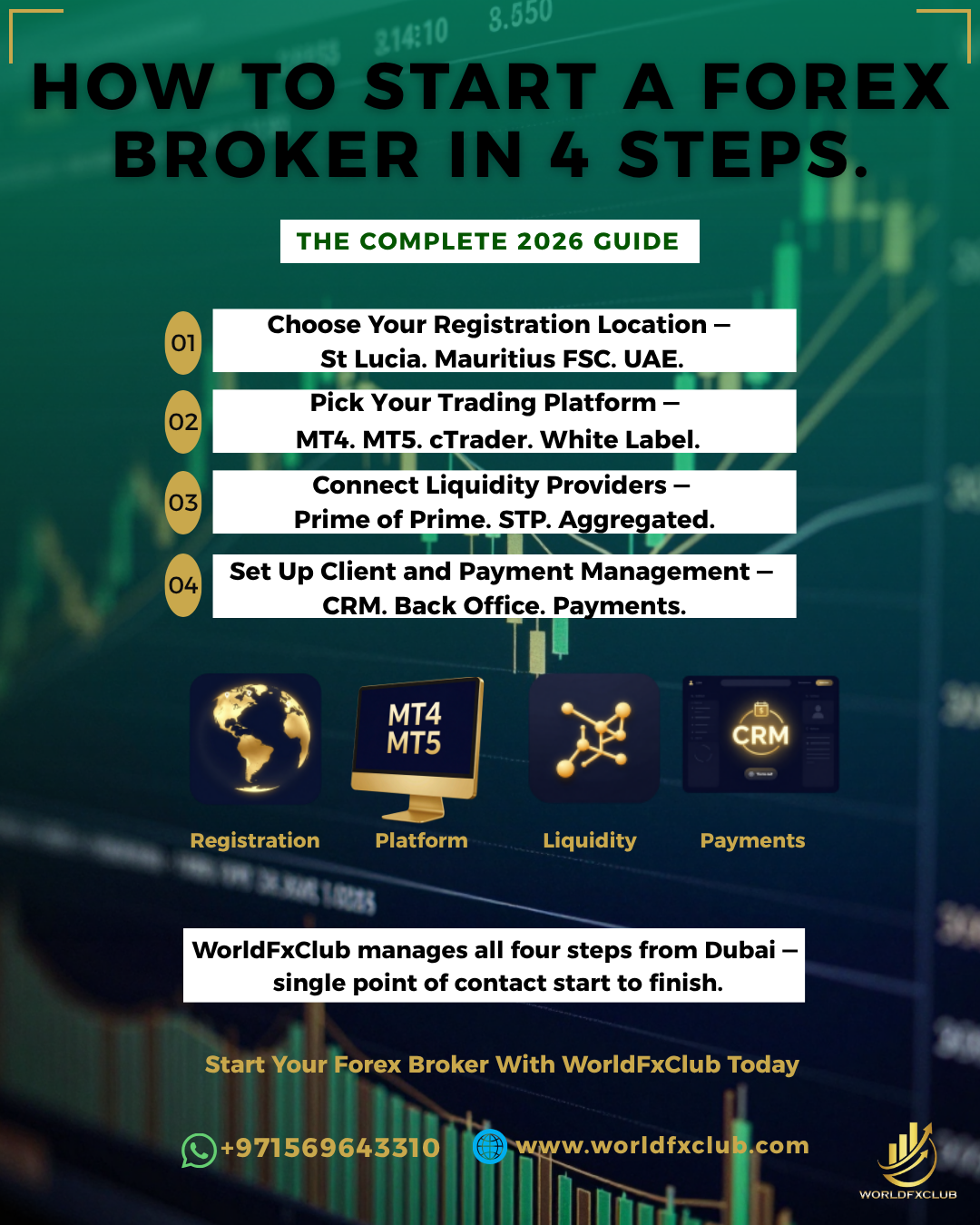
The four steps to starting a forex broker in 2026 are:
Step 1 — Choose your registration location
Step 2 — Pick a trading platform
Step 3 — Connect liquidity providers
Step 4 — Set up client and payment management systems
Each step builds on the previous one. Each step has specific decisions to make, specific documents to prepare and specific partners to engage. WorldFxClub manages every step from Dubai — giving founders a single point of contact for the complete broker setup process.
Step 1 — Choose Your Registration Location
Why Registration Location Is the Most Important Decision
Your registration location determines your regulatory status, banking access, tax efficiency and credibility with clients and partners. Consequently, choosing the wrong registration location creates structural problems that are expensive and time-consuming to fix later.
Furthermore, your registration location affects every other step in the process. It determines which trading platform partners are available, which liquidity providers will work with you and which payment processors and banking solutions your specific structure can access. Getting this decision right makes every subsequent step significantly easier.
The Registration Location Decision Framework
Every founder choosing a registration location needs to assess four factors:
Factor 1 — Speed. How quickly do you need to be operational? Some jurisdictions incorporate in 7 to 14 days. Others take 4 to 6 months from start to fully licensed. Your timeline determines which options are realistic.
Factor 2 — Budget. What is your total startup budget? Offshore structures cost significantly less than regulated jurisdictions. However they come with banking and credibility trade-offs that more expensive regulated structures avoid.
Factor 3 — Target markets. Where are your clients? Mauritius FSC carries strong credibility across Africa and Asia. UAE-based structures carry strong credibility in the Middle East. St Lucia provides broad international access at the lowest cost.
Factor 4 — Banking needs. What banking infrastructure does your broker model require? If you need premium banking partners and institutional credibility from day one, a regulated structure is the right starting point. If you need to launch fast and cost-effectively, St Lucia is the clear first choice.
Registration Location Options
St Lucia LLC — Fast and Affordable
St Lucia is the fastest and most cost-effective registration location for new forex broker founders. A St Lucia LLC incorporates in 7 to 14 days. It provides an internationally recognised corporate structure, MetaQuotes license eligibility and a straightforward ongoing compliance framework. Furthermore, annual renewal and tax filing are due by January 15th each year — a deadline WorldFxClub manages as standard for every St Lucia client.
St Lucia suits founders who need to launch quickly and build their client base before upgrading to a regulated structure. Consequently, many WorldFxClub clients start here and scale to Mauritius FSC as their business grows.
Mauritius FSC Investment Dealer License — Regulated and Credible
The Mauritius FSC Investment Dealer license is the regulated option for founders who need banking credibility and institutional relationships from launch. The total timeline is approximately 4 to 6 months. However, the FSC license gives brokers access to premium banking partners, a 3% effective tax rate on foreign-sourced income and strong credibility across African and Asian markets.
UAE-Based Structure — Local Market Presence
For founders targeting the UAE and Middle East market specifically, various UAE-based structures are available. These provide the strongest local market credibility. However, they also involve the highest setup costs and most complex compliance requirements. WorldFxClub advises on UAE-based structure options — including KHDA licensing consultation for forex educators and IBs — from our Dubai base.
What WorldFxClub Does at Step 1
WorldFxClub conducts a detailed initial consultation with every founder. Our Dubai-based team assesses their specific business model, target markets, budget, timeline and banking needs. Based on this assessment, WorldFxClub recommends the optimal registration location — and in many cases advises on a dual structure approach combining St Lucia and Mauritius FSC.
Step 2 — Pick a Trading Platform
Why the Trading Platform Decision Follows Registration Location
The trading platform decision comes after the registration location decision — not before. Your registration location directly affects which platform partners will work with you. MetaQuotes, for example, requires a properly incorporated company with complete corporate documentation before processing a white label license application. Without Step 1 completed correctly, Step 2 cannot proceed.
Furthermore, different platform providers have different requirements. Some require regulated status. Others accept offshore structures. Knowing your registration location before approaching platform providers ensures you approach the right partners with the right corporate structure already in place.
Trading Platform Options for New Forex Brokers
MetaTrader 4 — MT4
MT4 remains the most widely recognised trading platform in the retail forex market. It is the platform most traders are familiar with — making it the default choice for brokers targeting retail clients. White label arrangements give brokers the right to offer the platform under their own brand.
WorldFxClub provides setup support and guidance for MT4 white label arrangements. Our team helps founders understand what MetaQuotes requires and prepares the corporate documentation package. However, WorldFxClub does not set up MT4 directly — the MetaQuotes white label license is issued by MetaQuotes Software and platform setup is managed by the chosen technology provider.
MetaTrader 5 — MT5
MT5 is the newer generation MetaQuotes platform. It offers multi-asset trading capability beyond forex — including stocks, commodities and cryptocurrencies. Consequently, MT5 is increasingly preferred by brokers building a broader multi-asset offering or targeting more sophisticated traders.
cTrader
cTrader is a professional-grade trading platform developed by Spotware. It is known for its clean interface, advanced charting and ECN-style order execution. Furthermore, cTrader is particularly popular among brokers targeting experienced traders who prioritise execution quality and platform transparency.
Proprietary and White Label Alternatives
Beyond MetaTrader and cTrader, several proprietary trading platform solutions and turnkey white label alternatives are available. These range from full-service broker-in-a-box solutions to customisable web-based platforms designed for specific market segments. WorldFxClub advises on the full range of trading platform options — helping founders choose the platform that best fits their target market and budget.
Why White Label Is the Smart Starting Point
Building vs White Label — The Cost Reality
Building a proprietary trading platform from scratch costs hundreds of thousands of dollars. It also takes months or years to develop. In contrast, a white label arrangement licenses an established platform under your own brand at a fraction of that cost.
For most new forex broker founders in 2026, white label is therefore the clear starting point. It allows you to launch with a professional, recognised platform without the development investment. Furthermore, white label arrangements are typically operational within weeks — not years.
What WorldFxClub Does at Step 2
WorldFxClub advises on the optimal trading platform choice for each founder’s specific business model and target market. Our Dubai-based team prepares the complete corporate documentation package required for the platform white label license application — ensuring it meets the specific requirements of the chosen platform provider.
Step 3 — Connect Liquidity Providers
Why Liquidity Comes After Platform
Liquidity provider relationships follow the platform decision — not precede it. Your liquidity provider integration depends on which trading platform you are operating. Different liquidity providers support different platform integrations. Consequently, choosing your platform first ensures you approach liquidity providers with a compatible technology framework already in place.
Furthermore, liquidity providers conduct their own due diligence on new brokers. Your registration location, corporate structure and regulatory status all affect which providers will work with you. Having Steps 1 and 2 correctly in place before approaching liquidity providers therefore significantly improves the quality of relationships available to you.
What Is a Liquidity Provider?
A liquidity provider is a financial institution that gives your brokerage access to interbank forex market prices and trade execution. Without a liquidity provider, your trading platform cannot display live market prices or execute client trades. Consequently, the liquidity provider relationship is a foundational operational requirement — your brokerage cannot trade without it.
Liquidity Provider Types for New Forex Brokers
Prime of Prime Liquidity
Prime of Prime — or PoP — liquidity providers aggregate liquidity from multiple tier-one banks and offer it to smaller brokers. PoP liquidity is the most common solution for new forex brokers — offering deep liquidity pools, competitive spreads and professional execution infrastructure.
Straight Through Processing — STP
STP brokers pass every client trade directly to the liquidity provider. As a result, the broker has no market risk on client positions. The STP model is preferred by brokers who want to avoid the compliance complexity of holding market risk and want to build a business model based purely on spread markup.
Market Maker — MM
Market maker brokers take the other side of client trades internally. They manage client position risk internally rather than passing it to a liquidity provider. Market maker models can be more profitable than STP models. However, they carry higher operational complexity and regulatory scrutiny.
Aggregated Liquidity
Liquidity aggregators combine pricing from multiple liquidity providers to offer best execution across multiple sources. Aggregated liquidity typically delivers better execution quality and tighter spreads than single-source liquidity. Consequently, it is increasingly the preferred choice for brokers competing on execution quality.
What to Look for in a Liquidity Provider
New forex broker founders should assess liquidity providers on five criteria:
Minimum volume requirements — choose a provider with volume requirements that align with realistic early-stage trading volumes.
Platform compatibility — your liquidity provider must be technically compatible with your chosen trading platform. Technical incompatibility means the integration cannot proceed regardless of how good the liquidity terms are.
Onboarding requirements — your registration location and regulatory status affect which providers will work with you and how demanding their onboarding process is.
Pricing and spreads — the terms offered by your liquidity provider directly affect your brokerage’s profitability and competitiveness. Compare terms across multiple providers before committing.
Ongoing support — new brokers need responsive technical and commercial support from their liquidity provider — particularly during the launch period when integration issues arise frequently.
What WorldFxClub Does at Step 3
WorldFxClub advises on liquidity provider selection for every founder client. Our team identifies the most appropriate providers for each broker’s platform, registration location, business model and volume profile — and prepares the documentation required for liquidity provider due diligence.
Step 4 — Set Up Client and Payment Management Systems
Why Client and Payment Management Comes Last
Client and payment management systems are the final step — not because they are less important, but because their correct configuration depends on everything that comes before. Your CRM configuration depends on your business model. Your payment processor selection depends on your registration location and banking access. Furthermore, your back office setup depends on your trading platform integration.
Consequently, attempting to configure client and payment management systems before Steps 1 to 3 are in place creates configuration problems that are expensive to fix.
The Three Core Systems Every Forex Broker Needs
System 1 — CRM — Client Relationship Management
A CRM system manages every aspect of your client relationship — from initial lead capture and onboarding through to account management, communication and retention. For a forex broker, the CRM must handle lead management, KYC client onboarding, account management, retention workflows and management reporting.
Choosing the right CRM depends on your business model, target client volume and integration requirements. WorldFxClub advises on appropriate CRM solutions for each founder’s specific broker model. However, CRM setup and cost sit outside the company registration and compliance service and are managed separately.
System 2 — Back Office Management
System 2 — Back Office System
The back office system manages the operational and financial administration of the brokerage. It handles client account funding, withdrawal processing, account balance management, financial reporting and compliance reporting.
Furthermore, the back office system must integrate with both the trading platform and the payment processing infrastructure. Consequently, platform and payment decisions in Steps 2 and 3 are directly relevant to back office configuration in Step 4.
System 3 — Payment Processing Infrastructure
Payment processing infrastructure enables clients to deposit funds into their trading accounts and withdraw their funds. For a forex broker, payment processing must cover card processing, bank transfer processing, e-wallet integration, crypto payment processing where appropriate and efficient withdrawal execution across all accepted payment methods.
Your registration location directly affects which payment processors will work with your broker. St Lucia offshore brokers access EMI providers, offshore banking partners and niche fintech solutions. Mauritius FSC licensed brokers access premium banking partners with stronger payment processing infrastructure and more competitive terms. Therefore, the Step 1 registration decision has a direct impact on Step 4 payment options.
Client Onboarding — KYC and AML Compliance
Before any client can fund their trading account and begin trading, your brokerage must complete a KYC — Know Your Customer — verification process. This involves collecting and verifying client identity documents, proof of address and in some cases source of funds documentation.
Every forex broker — regardless of registration location — must implement KYC and AML compliance procedures as a fundamental operational requirement. WorldFxClub advises on the minimum KYC and AML infrastructure required for each registration location and broker model.
Broker Website — The Client-Facing Foundation
Your broker website is the public face of your brokerage. A professional, compliant broker website must include a clear description of your brokerage services and trading conditions, trading platform access, an integrated account opening process, legal documentation and client support access.
Broker website development is an additional charge that sits outside the company registration and compliance service. WorldFxClub can advise on appropriate website development partners for each founder’s specific broker model and budget.
What WorldFxClub Does at Step 4
WorldFxClub advises on the client and payment management system requirements for each founder’s specific broker model. Our Dubai-based team helps identify appropriate CRM, back office and payment processing solutions. Furthermore, WorldFxClub advises on the KYC and AML compliance infrastructure required for the chosen registration location — ensuring every client-facing process is compliant before launch.
The Complete Four Step Summary
| Step | What It Involves | WorldFxClub Role |
|---|---|---|
| Step 1 — Registration location | Assess jurisdiction options. Incorporate company. Set up compliance foundation. | Complete company incorporation licensing and annual compliance management |
| Step 2 — Trading platform | Choose MT4 MT5 cTrader or alternative. Apply for white label license. Set up platform. | Setup support guidance and corporate documentation preparation |
| Step 3 — Liquidity providers | Identify providers. Complete due diligence. Integrate with trading platform. | Liquidity provider selection advisory and onboarding documentation |
| Step 4 — Client and payment management | Configure CRM back office and payment processing. Implement KYC and AML. Launch website. | System selection advisory and KYC and AML compliance guidance |
Frequently Asked Questions
How Long Does It Take to Start a Forex Broker in 2026?
The timeline depends on your chosen registration location. A St Lucia LLC incorporates in 7 to 14 days — making it the fastest starting point for most founders. A Mauritius FSC Investment Dealer license takes approximately 4 to 6 months from start to fully licensed. Trading platform, liquidity and payment management setup runs in parallel with the registration process in most cases. WorldFxClub provides a precise timeline for each founder’s specific situation during the initial consultation.
What Is the Cheapest Way to Start a Forex Broker in 2026?
The most cost-effective approach combines a St Lucia LLC registration with a white label trading platform — minimising both the registration cost and the platform development cost simultaneously. WorldFxClub provides a personalised cost breakdown for each founder’s specific situation during the free initial consultation. Contact WorldFxClub via WhatsApp to get your real startup cost numbers.
Do I Need a Regulatory License to Start a Forex Broker?
Not necessarily — a St Lucia LLC provides a valid offshore corporate structure that many founders use to launch their brokerage. However, regulatory status affects your banking access, liquidity provider relationships, payment processing options and credibility with sophisticated clients. WorldFxClub advises on whether a regulated structure is the right starting point for each founder’s specific situation.
What Is the Difference Between MT4 and MT5 for a New Forex Broker?
MT4 is the most widely recognised platform for retail forex trading — the platform most traders are familiar with. MT5 is the newer generation platform offering multi-asset trading capability. For brokers targeting retail forex clients, MT4 is typically the starting point. For brokers building a broader multi-asset offering, MT5 is worth considering. WorldFxClub advises on the right platform choice during the initial consultation.
What Liquidity Provider Should I Use as a New Forex Broker?
The right liquidity provider depends on your trading platform, registration location, business model and expected trading volumes. WorldFxClub advises on liquidity provider selection for every founder client — identifying the most appropriate providers for each specific broker profile. Contact WorldFxClub via WhatsApp to discuss your liquidity provider options.
Does WorldFxClub Manage the Complete Four Step Forex Broker Setup?
Yes. WorldFxClub manages the complete forex broker setup process from Dubai — company registration in St Lucia or Mauritius FSC, trading platform setup support and guidance, liquidity provider selection advisory and client and payment management system guidance. Additionally, founders exploring KHDA licensing options in the UAE can access WorldFxClub’s complete multi-jurisdiction advisory from our Dubai base.
Start Your Forex Broker in 4 Steps With WorldFxClub Today
Starting a forex broker in 2026 follows a clear four-step framework — choose your registration location, pick your trading platform, connect your liquidity providers and set up your client and payment management systems. Get each step right in the correct sequence and your broker launches faster, costs less and operates more effectively from day one.
WorldFxClub manages the complete four-step forex broker setup from Dubai — giving founders across the UAE and internationally a single point of contact for every stage of the process.
Start your forex broker in 4 steps with WorldFxClub today: