If you are planning to start a forex broker — or if you already run a regulated brokerage — there is one strategic reality that most founders discover too late. Regulation gives you credibility. It gives you banking access. It gives you institutional relationships. However, regulation also takes something away — the freedom to offer your clients everything they actually want.
This is why every serious forex broker in the world — including the largest, most established regulated brokerages — operates with both a regulated entity and an offshore entity running simultaneously. The regulated entity builds trust and opens institutional doors. Furthermore, the offshore entity serves the actual client base with the full range of products, promotions and services that regulations prohibit.
Understanding this dual structure is not just interesting — it is essential for every forex broker founder who wants to build a competitive, scalable and profitable brokerage in 2026. WorldFxClub advises on both the offshore setup and the regulated pathway from our Dubai base — helping every founder build the right structure for their specific stage of growth.
What Regulation Actually Restricts
The Freedom That Regulation Takes Away
Most new forex broker founders approach regulation as a purely positive step — more credibility, better banking, institutional access. All of that is true. However, regulation also introduces a framework of restrictions that directly limits what a broker can offer its clients. Furthermore, these restrictions are not minor inconveniences — they are fundamental limitations on the product offering, the marketing approach and the client experience that regulated brokers can deliver.
The most impactful restrictions fall into four categories — leverage limits, bonus restrictions, copy trading limitations and fund management constraints. Each one represents a product or service that offshore brokers can offer freely. Consequently, regulated brokers who do not maintain an offshore entity alongside their regulated structure consistently lose clients to offshore competitors who face none of these limitations.
Restriction 1 — Leverage Limits
Leverage is the most commercially significant restriction that regulated brokers face. Major regulatory jurisdictions impose strict leverage caps on retail forex and CFD accounts. In the EU, ESMA limits retail leverage to 30:1 on major currency pairs and significantly lower on other instruments. Furthermore, in the UK, the FCA applies similar restrictions. In Australia, ASIC has tightened leverage limits dramatically over recent years.
These leverage caps exist to protect retail clients from excessive risk. However, they also fundamentally limit the attractiveness of the regulated broker’s offering to experienced traders who specifically seek higher leverage. A trader who wants 500:1 leverage on a major currency pair will not trade with a regulated EU broker — regardless of how strong the brand is. Furthermore, this trader represents exactly the high-volume, high-activity client that brokers most want to attract. Consequently, regulated brokers without an offshore entity lose these clients entirely to offshore competitors.
An offshore entity — particularly a St Lucia IBC — operates without the leverage restrictions imposed by regulated jurisdictions. Consequently, St Lucia-based brokers can offer leverage levels that attract high-volume traders whom regulated entities simply cannot serve.
Restriction 2 — Bonus Restrictions
Bonuses and promotions are one of the most powerful client acquisition tools in the retail forex broker market. Deposit bonuses, trading credit bonuses, cashback promotions and loyalty programmes all drive client acquisition and retention at significantly lower cost than paid advertising alone.
However, most major regulatory frameworks impose strict restrictions on bonuses and promotions for retail forex brokers. The EU’s MiFID II framework effectively prohibits deposit bonuses for retail clients. The UK FCA applies similar restrictions. These rules exist to prevent inducements that encourage clients to take on excessive risk. However, they simultaneously remove one of the most effective client acquisition tools available to a retail forex broker.
An offshore entity operates without these bonus and promotion restrictions. Consequently, offshore brokers can run deposit bonuses, trading contests, cashback programmes and loyalty schemes freely. Furthermore, for brokers targeting emerging markets — particularly in the Middle East, Africa and Asia — bonus promotions are often the primary client acquisition driver. Therefore, an offshore entity is not just convenient — it is commercially essential for these markets.
Restriction 3 — Copy Trading
Copy trading — the ability for clients to automatically replicate the trades of experienced traders — is one of the fastest-growing product categories in the retail forex space. Furthermore, it attracts a specific and highly valuable client demographic — new and less experienced traders who want market exposure without developing their own trading skills.
However, many regulated jurisdictions apply restrictions to copy trading that significantly limit how a regulated broker can offer this product. In some jurisdictions, copy trading is classified as a form of investment management — requiring additional licensing beyond the standard Investment Dealer license. Consequently, regulated brokers who want to offer copy trading face a complex and expensive additional licensing process.
An offshore entity can offer copy trading freely — without the regulatory classification complexity that restricts regulated brokers. Furthermore, once a client is onboarded through a copy trading product at the offshore entity, they become a long-term relationship that generates ongoing revenue. Consequently, the offshore copy trading offering becomes one of the most valuable client acquisition channels available to a dual-structure broker.
Restriction 4 — Fund Management
Fund management — the ability to manage client funds discretionarily, operate PAMM accounts or offer MAM account structures — is another category where regulation imposes significant constraints. Most regulated jurisdictions require additional licensing for fund management activities — separate from and more demanding than the standard forex broker license.
Furthermore, the compliance obligations associated with regulated fund management are substantially higher than for standard brokerage activity. This creates cost and complexity barriers that many brokers — particularly those at earlier growth stages — cannot efficiently manage alongside their core brokerage operation.
An offshore entity can offer fund management, PAMM accounts and MAM structures with significantly less regulatory complexity. Consequently, offshore entities serve as the natural home for fund management product offerings — particularly for brokers who want to attract high-net-worth clients and sophisticated investors.
Why Regulated Brokers Still Need Offshore Entities
The Reality of How Regulated Brokers Actually Operate
Here is the reality that most forex broker marketing does not acknowledge openly. The vast majority of clients that regulated forex brokers serve are actually onboarded through offshore entities — not through the regulated entity itself.
The regulated entity exists primarily for trust and legitimacy signalling. It gives the brand the regulatory credentials that sophisticated clients, institutional partners, banking partners and liquidity providers look for. Furthermore, it demonstrates that the operator has met a recognised regulatory standard — building confidence in the brand across all client segments, including those who ultimately trade through the offshore entity.
The offshore entity is where the actual business happens for most broker client segments. Offshore clients get higher leverage. Furthermore, they get bonus promotions, copy trading and fund management products. Consequently, the offshore entity is not a fallback or a compromise — it is the primary client-serving vehicle for the majority of the broker’s client base.
The Trust Credibility Loop
This creates a powerful dynamic that the most successful forex brokerages in the world have understood and built their business models around. The regulated entity generates trust and credibility that benefits the entire brand — including the offshore entity operating under the same brand name. Clients who trade with the offshore entity feel more confident because the brand holds a regulatory license — even though their own account sits in the offshore entity.
Furthermore, the regulated entity opens banking relationships, liquidity provider partnerships and institutional connections that benefit the entire operation. Consequently, the regulated entity and the offshore entity work together as a mutually reinforcing system — with each component making the other more effective.
What This Means for Every Forex Broker Founder
If you are planning to start a forex broker in 2026 — whether you intend to eventually get regulated or not — understanding this dual structure is the single most important strategic insight you can have before you start.
The offshore entity is not a temporary arrangement. It is not something you retire when regulation arrives. Furthermore, it is not a second-class option that eventually gets replaced. It is a permanent, essential component of a properly structured forex brokerage — serving the client segments, product categories and markets that regulation either cannot serve or serves only with significant commercial disadvantage.
The Smart Growth Strategy — Offshore First, Then Regulated
Why Starting Offshore Is the Right Move for Most Founders
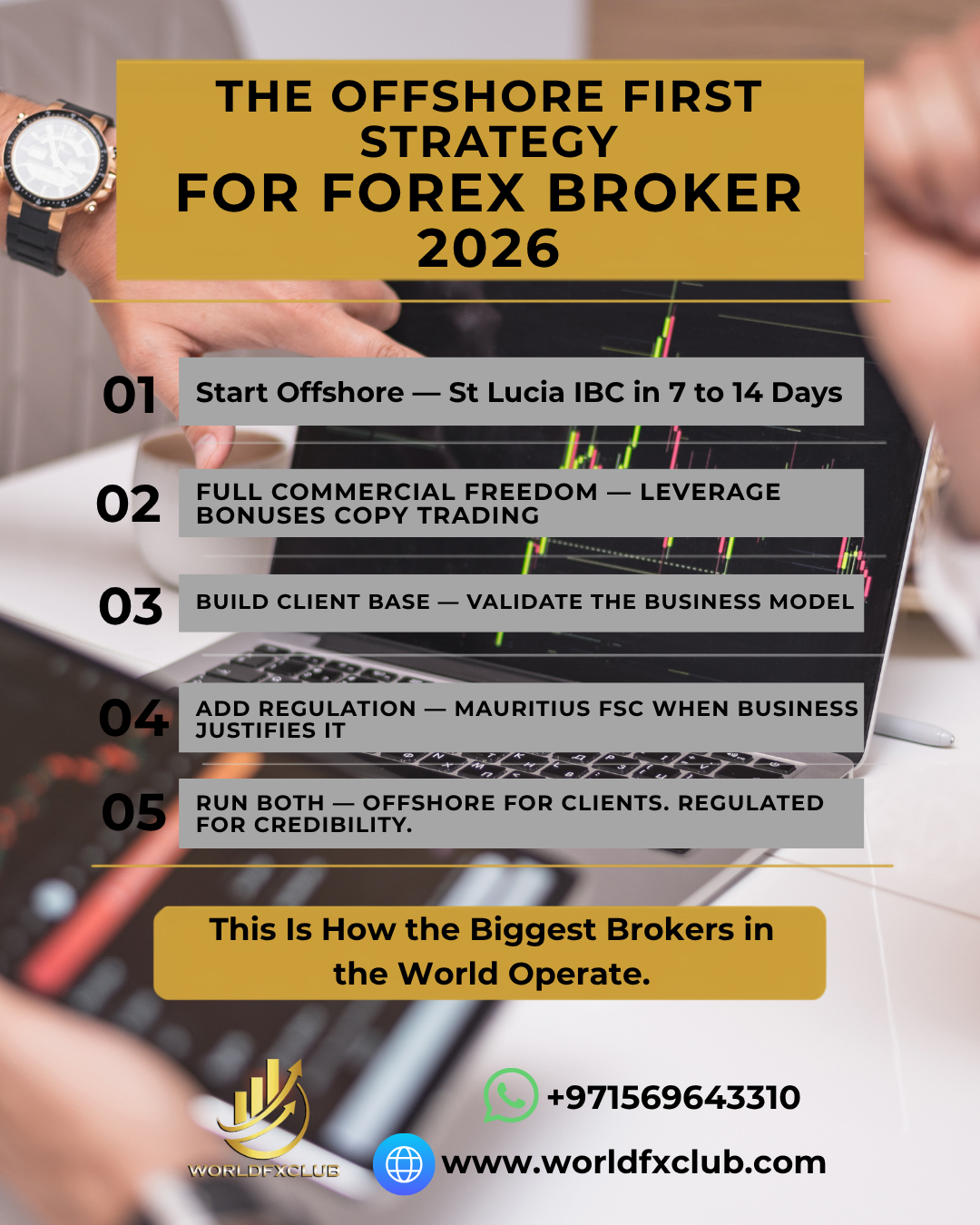
For most forex broker founders in 2026, the right strategic sequence is to start with an offshore entity and build toward regulation — rather than attempting to launch a fully regulated broker from day one.
The reasons are straightforward. First, an offshore entity launches significantly faster and at a fraction of the cost of a regulated structure. A St Lucia IBC incorporates in 7 to 14 days. In contrast, a Mauritius FSC Investment Dealer license takes 4 to 6 months from GBC incorporation to FSC approval. Consequently, the offshore-first approach gets the broker to market faster — generating revenue and validating the business model before the significant investment of a regulated license application is made.
Second, the offshore entity generates the revenue and client base that validates the regulated license investment. A broker that launches regulated without first validating its model makes a significant financial commitment. It does so before proving the model actually works. Furthermore, the revenue generated by the offshore entity can fund the regulated license application. This makes the regulatory upgrade self-financing over time.
Third, the offshore entity gives the broker the product freedom to compete effectively in target markets from day one. Consequently, the broker arrives at the regulated license application with a proven, profitable operation — rather than a nascent business that has yet to demonstrate commercial viability.
The Offshore-First Roadmap — Stages 1 to 3
Stage 1 — Offshore Launch
Start with a St Lucia IBC. Incorporate in 7 to 14 days. Launch with the full product offering — leverage, bonuses, copy trading, fund management — that the target client base wants. Build the client base. Validate the business model. Generate revenue. Annual renewal and tax filing are due by January 15th each year — WorldFxClub manages this as standard for every St Lucia client.
Stage 2 — Build the Brand and Client Base
Use the offshore entity to build the brand, the community and the client base. Invest the revenue from offshore operations into marketing, platform development and client acquisition. Furthermore, the offshore entity’s freedom to offer bonuses, high leverage and copy trading gives the brand competitive advantages that drive client acquisition cost-effectively in target markets.
Stage 3 — Identify the Right Regulated Jurisdiction
As the business grows and specific geographic markets emerge as the primary client base, identify the regulated jurisdiction that gives the brand the most credibility in those specific markets. For African and Asian markets, the Mauritius FSC Investment Dealer license is frequently the strongest choice. WorldFxClub advises on the right regulatory jurisdiction for each specific client’s target market profile.
Executing the Regulatory Upgrade
Stage 4 — Add the Regulated Entity
Apply for the regulated license — Mauritius FSC or the appropriate jurisdiction for the target markets — while keeping the offshore entity active and operational. The regulated entity adds credibility and opens institutional doors. Furthermore, the offshore entity continues to serve the client base with the full product offering. Consequently, the business does not lose any clients or revenue during the regulatory transition — it adds credibility while maintaining full commercial capability.
Stage 5 — Run Both Simultaneously
This is the permanent state for most successful forex brokerages. The regulated entity and the offshore entity operate simultaneously — each serving its specific purpose. WorldFxClub manages both structures from Dubai — providing a single point of contact for the complete dual-structure operation.
Why St Lucia Is the Right Offshore Starting Point
Speed, Cost and Freedom
For most forex broker founders starting the offshore-first journey, St Lucia is the right starting point. A St Lucia IBC incorporates in 7 to 14 days. It requires no minimum capital. It allows 100% foreign ownership. Furthermore, it carries zero corporate tax on offshore income. It also provides MetaQuotes license eligibility — giving the broker access to MT4 and MT5 platforms from day one.
Most importantly, a St Lucia IBC operates without the regulatory restrictions that limit what the broker can offer clients. High leverage. Bonus promotions. Copy trading. Fund management structures. All available. All compliant. All serving the client base that the regulated entity cannot serve on its own. Consequently, the St Lucia IBC is not just a starting point — it is a permanent operational component of a properly structured dual-entity brokerage.
The January 15th Annual Renewal Deadline
Every St Lucia IBC must complete its annual renewal before January 15th each year — including annual accounting and tax filing. This deadline is fixed and carries no grace period. Consequently, missing it creates immediate penalties and non-compliant company status. WorldFxClub manages the complete annual renewal cycle for every St Lucia client as standard — ensuring the deadline is never missed regardless of how busy the business operation becomes.
The Natural Upgrade Path
When the offshore business has validated its model and the regulatory upgrade makes strategic sense, WorldFxClub manages the complete transition to a Mauritius FSC Investment Dealer license. This covers GBC incorporation, FSC application, management company substance arrangement, banking introductions and ongoing FSC annual compliance. Consequently, the upgrade from offshore to dual-structure operation is a managed, strategic process — not a disruptive reorganisation.
Frequently Asked Questions
Why Do Regulated Forex Brokers Need an Offshore Entity?
Regulated forex brokers need an offshore entity because most regulatory frameworks impose restrictions — on leverage, bonuses, copy trading and fund management — that limit what the broker can offer its clients. An offshore entity operates without these restrictions. Furthermore, the vast majority of clients that regulated brokers actually serve are onboarded through offshore entities — not through the regulated entity itself. WorldFxClub manages both structures from Dubai.
Is It Legal to Run Both a Regulated Entity and an Offshore Entity?
Yes. Running both a regulated entity and an offshore entity is standard practice across the forex brokerage industry. The key is ensuring that each entity operates within the regulatory framework applicable to its jurisdiction. Furthermore, clients onboarded in each entity must receive the disclosures and protections appropriate to that entity’s structure. WorldFxClub advises on the correct structural and compliance approach for each component of a dual-structure forex brokerage.
What Are the Main Restrictions That Regulation Imposes on Forex Brokers?
The main restrictions that regulation imposes on forex brokers are leverage limits — typically 30:1 or lower for retail clients in major regulated jurisdictions — bonus and promotion restrictions, copy trading limitations and fund management licensing requirements. Each of these restrictions limits the broker’s ability to compete for specific client segments. Furthermore, each limits the broker’s ability to offer products that offshore competitors can offer freely.
Why Should I Start With an Offshore Entity Rather Than Going Regulated From Day One?
Starting with an offshore entity is faster, less expensive and commercially more flexible than launching a fully regulated broker from day one. A St Lucia IBC incorporates in 7 to 14 days. In contrast, a regulated license takes 4 to 6 months at minimum. Furthermore, the offshore entity generates the revenue and client base that validates the regulated license investment. WorldFxClub advises on the optimal timing and approach for the regulatory upgrade for each specific client situation.
Does WorldFxClub Manage Both the Offshore and Regulated Structures?
Yes. WorldFxClub manages the complete dual-structure forex brokerage setup from Dubai — St Lucia IBC offshore setup, Mauritius FSC Investment Dealer license regulated structure and KHDA licensing for Dubai-based education and IB activities. Our team provides a single point of contact for the complete dual-structure operation — from initial offshore launch through to regulated upgrade and ongoing annual compliance management for both entities simultaneously.
WhatsApp WorldFxClub to Start Your Offshore Setup Today
Every serious forex broker needs both an offshore entity and a regulated entity — and understanding why is the most important strategic insight a forex broker founder can have in 2026. The offshore entity gives you commercial freedom. Furthermore, the regulated entity gives you credibility and institutional access. Together they create a forex brokerage that can compete across every client segment, every market and every product category.
WorldFxClub manages the complete dual-structure forex brokerage setup from Dubai — St Lucia offshore launch, Mauritius FSC regulated upgrade and ongoing annual compliance management for both structures simultaneously.
Book a free consultation with WorldFxClub Dubai today: