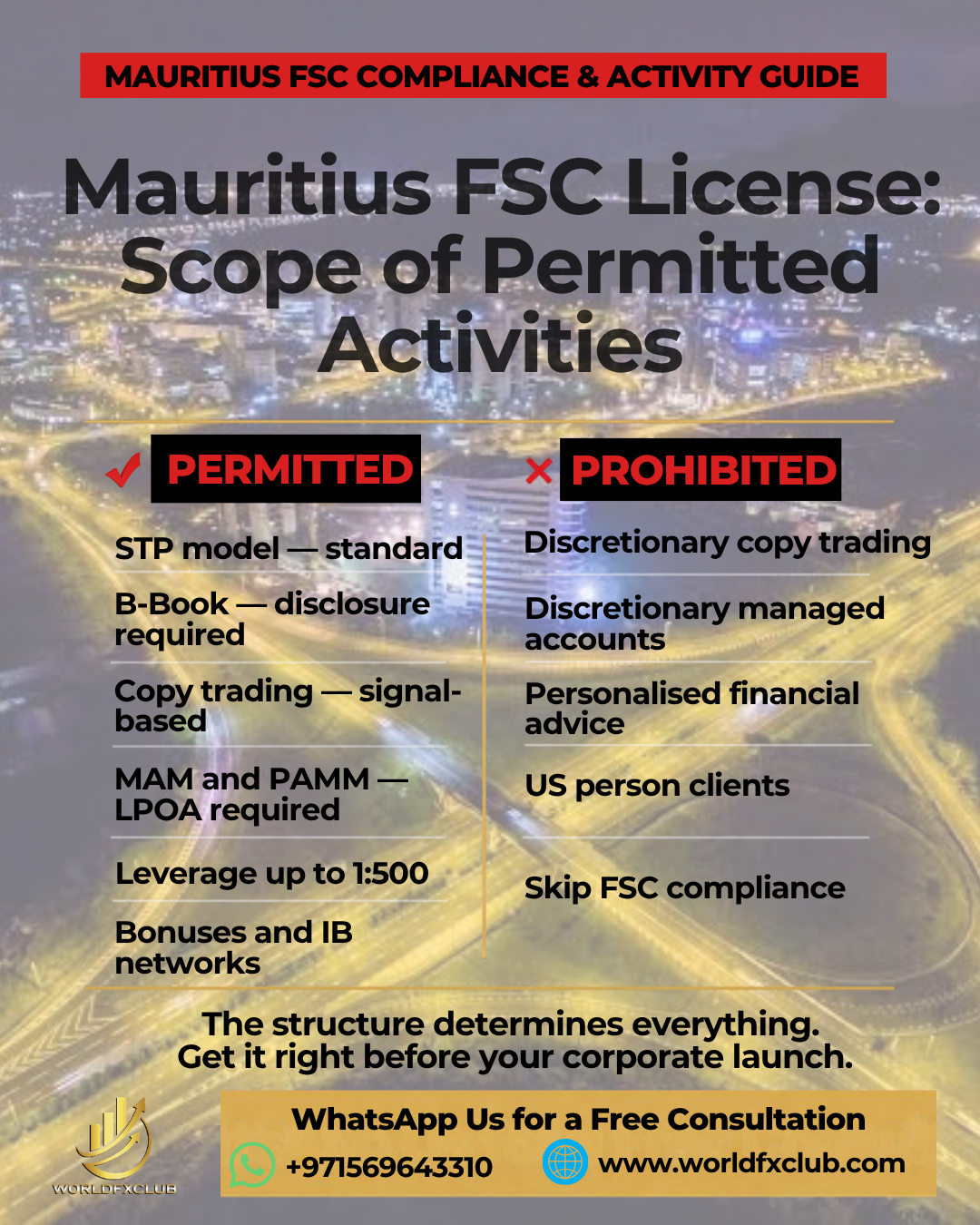
The Mauritius forex license — formally known as the Investment Dealer license issued by the Financial Services Commission of Mauritius — is one of the most commercially significant regulatory credentials available to a retail forex broker operating in the international market in 2026.
Furthermore, it is one of the most misunderstood. Many broker founders approach the Mauritius FSC license with an incomplete picture of what it actually permits — what activities the license covers, what it restricts, what complementary structures are needed to operate a full-service retail brokerage and why the Mauritius regulatory framework carries the institutional credibility it does in the global financial services market.
Consequently, this blog provides the most complete and practical explanation of the Mauritius forex license available to every broker founder considering the FSC Investment Dealer license as the regulatory foundation for their brokerage in 2026. WorldFxClub advises on the complete Mauritius FSC license application and post-license compliance management from our Dubai base.
What Is the Mauritius Forex License
The Investment Dealer License
The Mauritius forex license is the Investment Dealer license issued by the Financial Services Commission of Mauritius — the FSC. Furthermore, it is not a single monolithic license but a category of license that covers several specific activity types. The scope of permitted activities is determined by the specific sub-category of Investment Dealer license the broker holds.
The FSC issues the Investment Dealer license under the Securities Act 2005 and the Securities Licensing Rules 2007. Furthermore, the license authorises the holder to deal in securities. Under Mauritius law this category includes forex, CFDs, equities, commodities, derivatives and other financial instruments. Consequently, the Investment Dealer license is the appropriate regulatory foundation for a retail forex and CFD broker operating under Mauritius jurisdiction.
The FSC operates as Mauritius’s integrated financial services regulator for the non-banking sector. Furthermore, it is a full member of IOSCO — the International Organisation of Securities Commissions. This places it in the same regulatory tier as the FCA, ASIC, MAS and CySEC. Consequently, the Mauritius FSC Investment Dealer license carries a level of institutional credibility that banking partners, liquidity providers, institutional counterparties and sophisticated retail clients all recognise internationally.
What You Can Do Under the Mauritius Forex License
Permitted Activities — The Scope of the Investment Dealer License
The Investment Dealer license authorises a broad range of activities relevant to the operation of a retail forex and CFD brokerage. Furthermore, the specific activities permitted under any individual license depend on the sub-category held. Consequently, every FSC licensee must ensure that every activity they conduct falls within the specific scope of their licensed activities — and WorldFxClub advises every broker client on the correct license sub-category for their specific business model before the application is submitted.
You Can Deal in Forex and CFDs as Principal or Agent
The Investment Dealer license authorises the holder to deal in foreign exchange instruments and contracts for difference — both as principal and as agent. Furthermore, this covers the full range of retail forex and CFD products. These include currency pairs, commodities, indices, cryptocurrencies and equity CFDs. Consequently, a Mauritius FSC Investment Dealer license is the appropriate regulatory foundation for any broker that wants to offer a comprehensive retail forex and CFD product suite to international clients.
You Can Operate an STP or Agency Execution Model
The Investment Dealer license supports the STP — Straight Through Processing — model and the agency execution model. Furthermore, in an STP structure every client trade passes directly to the liquidity provider for execution — with the broker earning from the spread markup rather than taking a position against the client. Consequently, the Mauritius FSC license is entirely appropriate for the STP execution model. WorldFxClub recommends this as the standard structure for every community-built retail broker.
You Can Operate a B-Book Model — With Conditions
The Investment Dealer license permits the holder to deal as principal — meaning the broker takes the other side of client trades. This is the B-book model. Furthermore, the Investment Dealer license permits the B-book model. However, it carries specific compliance requirements that every FSC licensee must meet.
Disclosure — the broker must disclose to clients in its terms and conditions that it may act as principal. Furthermore, the broker must document this conflict of interest clearly in their conflict of interest policy. Consequently, any broker operating a B-book under the FSC license must have a documented and disclosed conflict of interest framework before any B-book activity begins.
Capital adequacy — running a B-book creates market risk on the broker’s balance sheet. Furthermore, the FSC expects every licensee operating a B-book to maintain adequate capital to cover this market risk exposure. Consequently, the broker must factor B-book capital requirements into capital planning before activating the B-book model.
Risk management framework — the broker must document a risk management framework covering position limits, hedging policy and market risk management. Furthermore, the broker must review and update this framework regularly as the client base and trading volumes grow. Consequently, WorldFxClub advises every FSC licensee on the correct B-book risk management structure before any B-book activity commences.
WorldFxClub recommendation — for community-built brokers the STP model remains the recommended approach. Furthermore, the B-book model creates both regulatory risk and reputational risk for any broker whose clients know and trust the founder personally. Consequently, WorldFxClub advises on the correct structural and disclosure approach for every FSC licensee that wants to run a hybrid model.
You Can Offer Leverage to Retail Clients — Up to 1:500
The FSC does not publish a single fixed maximum leverage cap in the way that the FCA or ESMA do. However, in practice most Mauritius FSC licensed brokers offer leverage up to 1:500 for major forex pairs to retail clients. Furthermore, the FSC may apply lower caps to specific asset classes — particularly cryptocurrencies and exotic instruments. The broker must document and justify every leverage level in their risk management framework. Consequently, the leverage offering must be clearly documented and disclosed to clients before any leveraged product is offered.
Professional clients who qualify under the FSC’s client classification rules may be offered higher leverage than retail clients. Furthermore, the FSC reviews leverage practices during supervisory reviews — making the risk management documentation around leverage one of the most important compliance documents a Mauritius FSC licensee maintains. Consequently, WorldFxClub advises every FSC licensee on the correct leverage framework and risk management documentation for their specific product offering and target client profile.
You Can Offer Copy Trading — With Correct Structure
Copy trading can be offered under the Investment Dealer license. However, the structure of the copy trading offering determines whether it falls within the permitted scope of the Investment Dealer license. Some structures require an additional license category.
Signal-based copy trading — where the follower client chooses to copy a signal provider and each trade executes as a separate client instruction — falls within the dealing activity the Investment Dealer license permits. Furthermore, this is the most common and most appropriate copy trading structure for an FSC Investment Dealer licensee. Consequently, a signal-based copy trading platform is permitted under the Investment Dealer license — provided the follower client retains the decision to copy and the structure does not constitute discretionary management.
Fully discretionary copy trading — where the signal provider has full control over follower accounts without individual client consent per trade — constitutes discretionary portfolio management. Furthermore, the Investment Dealer license does not permit discretionary portfolio management. It requires an Investment Manager license from the FSC. Consequently, every FSC licensee that wants to offer copy trading must structure the product carefully — and WorldFxClub advises on the correct copy trading structure for every FSC licensee before launch.
You Can Offer MAM and PAMM Accounts — With LPOA Requirements
MAM — Multi Account Manager — and PAMM — Percentage Allocation Management Module — accounts are permitted under the Investment Dealer license — but only when the broker structures them correctly around a Limited Power of Attorney framework.
MAM accounts — where a money manager executes trades allocated proportionally across multiple client accounts — are permitted under the Investment Dealer license. Furthermore, every client account participating in the MAM must have signed a Limited Power of Attorney. This authorises the money manager to trade on their behalf. Consequently, the LPOA is the critical compliance document that makes MAM accounts permissible under the Investment Dealer license.
PAMM accounts — where client funds are pooled under a money manager with proportional profit and loss allocation — operate under the same framework as MAM accounts. Furthermore, every participating client must sign an LPOA and receive clear risk disclosure before participating. Consequently, the PAMM structure must include the client’s right to withdraw from the PAMM at any time — and the broker must clearly document this right in the PAMM terms and conditions.
The critical compliance requirements for MAM and PAMM:
Every MAM and PAMM structure under the Investment Dealer license must include a signed LPOA from every participating client. Furthermore, clear risk disclosure, the client’s documented right to withdraw at any time and the money manager’s disclosed activities in the compliance framework are all non-negotiable. Consequently, WorldFxClub advises on the correct MAM and PAMM structure for every FSC licensee before any managed account product is launched.
You Can Onboard International Retail and Professional Clients
The Mauritius forex license permits the licensee to onboard and service both retail and professional clients from international markets. Furthermore, the license specifically supports the international business model — where the licensed entity in Mauritius services clients across multiple global jurisdictions. Consequently, a Mauritius FSC licensed broker can accept clients from the Middle East, Africa, Southeast Asia, South Asia, Europe and other international markets — subject to the applicable marketing and solicitation rules in each target jurisdiction.
You Can Introduce an IB and Affiliate Network
A Mauritius FSC licensed broker can operate an IB network and an affiliate programme. Furthermore, the license permits the broker to pay commissions, revenue shares and other compensation structures to introducing brokers and affiliates who refer clients to the broker. Consequently, the Mauritius forex license is fully compatible with the partner network distribution model that most retail forex brokers rely on for a significant proportion of their client acquisition.
You Can Offer Bonuses and Promotions
The Mauritius FSC does not prohibit deposit bonuses, cashback schemes and other client promotional structures — unlike the restrictive rules that apply to brokers regulated in the EU, UK and Australia. Furthermore, the ability to offer bonuses and promotions is a commercially significant advantage for brokers targeting clients in markets where promotional incentives are a standard part of the competitive landscape. Consequently, a Mauritius FSC licensed broker can deploy the full range of client acquisition and retention promotional tools available to offshore brokers — but with the added credibility of an internationally recognised regulated status.
You Can Access Better Banking and LP Relationships
A Mauritius FSC Investment Dealer license materially improves the broker’s access to banking partners, liquidity providers and institutional counterparties. Furthermore, mainstream banks, tier-one payment processors and institutional LPs that decline offshore registered entities will consider and often approve applications from Mauritius FSC licensed entities. Consequently, the Mauritius forex license directly expands the quality and range of the broker’s operational infrastructure — improving the client experience and the broker’s competitive positioning simultaneously.
You Can Display Regulatory Credentials to Clients
A Mauritius FSC licensed broker can display its FSC license number and FSC registration details on all client-facing communications — including the broker’s website, client portal, terms and conditions and marketing materials. Furthermore, the FSC maintains a public register of licensed entities that any prospective client can verify independently. Consequently, the Mauritius forex license provides a verifiable government-backed credibility credential that directly improves client acquisition conversion rates.
What You Cannot Do Under the Mauritius Forex License
The Restrictions and Limitations of the Investment Dealer License
Understanding what the Mauritius forex license does not permit is as important as understanding what it does. Furthermore, every FSC licensee must operate strictly within the scope of their licensed activities — compliance breaches carry regulatory consequences that can affect the license itself. Consequently, WorldFxClub advises every broker client on the specific restrictions applicable to their license sub-category before any client-facing activity begins.
You Cannot Provide Personalised Financial Advice
The Investment Dealer license does not authorise the holder to provide personalised financial advice — individually tailored recommendations about specific investments, trading strategies or portfolio management decisions — to retail clients. Furthermore, this distinction between dealing and advising is critically important. Any broker that also operates an education or signal service alongside the brokerage must understand it clearly. Consequently, broker activities that cross the line from education into personalised investment advice require a separate Investment Adviser license. WorldFxClub advises every broker client on this distinction before any client communication programme is designed.
You Cannot Manage Client Funds Fully Discretionarily
The Investment Dealer license does not authorise the holder to manage client funds on a fully discretionary basis — making investment decisions on behalf of clients without a Limited Power of Attorney and without individual client consent for each trading mandate. Furthermore, fully discretionary portfolio management requires the Investment Manager license from the FSC. This applies either in addition to or instead of the Investment Dealer license. Consequently, any broker that wants to offer managed accounts beyond the LPOA-based MAM and PAMM structure must obtain the appropriate additional license — and WorldFxClub advises on the correct structural approach for every broker that wants to offer these products.
You Cannot Offer Fully Discretionary Copy Trading
Fully discretionary copy trading — where the signal provider has full control over follower accounts without individual client consent per trade — constitutes discretionary portfolio management. The Investment Dealer license does not permit this activity. Furthermore, this restriction applies regardless of how the product is marketed. If the substance of the arrangement is that one party makes trading decisions for another without per-trade consent, it is discretionary management. Consequently, every FSC licensee that wants to offer copy trading must use the signal-based structure — and WorldFxClub advises on the correct copy trading structure before launch.
You Cannot Solicit Clients in Restricted Jurisdictions Without Local Compliance
The Mauritius FSC Investment Dealer license does not override the domestic regulatory requirements of the jurisdictions where the broker’s clients are located. Furthermore, soliciting clients in jurisdictions with specific marketing restrictions requires compliance with the applicable local rules. These jurisdictions include the United States, Japan, Canada and certain EU member states. Consequently, every Mauritius FSC licensed broker must maintain a clear and current understanding of the marketing restrictions applicable in every jurisdiction where it actively solicits retail clients.
You Cannot Accept US Persons as Clients
The United States applies extraterritorial regulatory requirements — particularly through CFTC and SEC regulation — that effectively prohibit offshore forex brokers from accepting US persons as clients. Furthermore, this restriction applies regardless of the broker’s regulatory status in any other jurisdiction — including Mauritius. Consequently, every Mauritius FSC licensed broker must implement effective procedures to identify and decline US person clients — both at onboarding and on an ongoing basis.
You Cannot Operate Without Meeting Ongoing Compliance Obligations
The Mauritius FSC Investment Dealer license carries significant ongoing compliance obligations — annual regulatory filings, compliance audits, AML reporting, transaction monitoring, maintaining a qualified compliance officer and meeting the FSC’s ongoing capital adequacy requirements. Furthermore, the FSC conducts periodic supervisory reviews of every licensed entity. Consequently, the Mauritius forex license is an ongoing operational commitment that requires consistent investment in compliance infrastructure — and WorldFxClub provides ongoing compliance management for every FSC license holder as a standard post-license advisory service.
Complete Activity Reference Table
| Activity | Permitted Under Investment Dealer License? | Conditions |
|---|---|---|
| Forex and CFD dealing — STP model | ✅ Yes | Standard |
| Forex and CFD dealing — B-book model | ✅ Yes | Disclosure, conflict of interest policy, capital adequacy, risk management framework |
| Leverage up to 1:500 for major forex pairs | ✅ Yes | Must be documented in risk management framework |
| Copy trading — signal based | ✅ Yes | Follower retains decision to copy — no discretionary management |
| Copy trading — fully discretionary | ❌ No | Requires Investment Manager license |
| MAM accounts — LPOA based | ✅ Yes | Signed LPOA, risk disclosure, withdrawal rights documented |
| PAMM accounts — LPOA based | ✅ Yes | Signed LPOA, risk disclosure, withdrawal rights documented |
| Fully discretionary managed accounts | ❌ No | Requires Investment Manager license |
| IB and affiliate network | ✅ Yes | Standard |
| Deposit bonuses and promotions | ✅ Yes | Standard |
| International retail and professional clients | ✅ Yes | Subject to target jurisdiction marketing rules |
| Better banking and LP access | ✅ Yes | Standard benefit of FSC status |
| Verified regulatory credentials display | ✅ Yes | Standard |
| Personalised financial advice | ❌ No | Requires Investment Adviser license |
| US person clients | ❌ No | CFTC and SEC extraterritorial rules apply |
| Soliciting in restricted jurisdictions | ❌ No | Requires local compliance in each jurisdiction |
Why an Offshore License Is Required to Provide Better Services
The Commercial Limitations of Operating Without Regulation
Many retail forex brokers start their journey under a pure offshore corporate structure — a St Lucia IBC, a Seychelles IBC or a similar offshore entity — without any regulatory license. Furthermore, this approach is commercially appropriate in the early stages — when the priority is validating the business model at low cost and high speed. Consequently, the offshore-only structure serves a clear purpose in the broker lifecycle — but it also has equally clear commercial limitations that become increasingly significant as the broker grows.
An offshore-only broker can legally operate a forex brokerage. However, it faces structural commercial constraints that a regulated broker does not. Furthermore, these constraints affect every commercially significant aspect of the broker’s operation. Banking access, LP relationships, IB recruitment, client credibility and regulated market access are all impacted. Consequently, the offshore-only broker consistently operates at a commercial disadvantage relative to its regulated competitors as the business matures.
The Mauritius FSC License Removes the Commercial Constraints
Banking access — a Mauritius FSC licensed broker accesses a materially better tier of banking relationships than an offshore-only entity. Mainstream banks and tier-one payment processors that decline offshore entities will consider FSC licensed applicants. Furthermore, better banking means lower transaction costs, higher volume limits and more reliable payment processing. Consequently, the banking improvement directly improves the broker’s client experience and operational cost structure.
Liquidity provider relationships — tier-one LPs and prime brokers typically require regulatory status as a prerequisite for their institutional pricing tiers. Furthermore, better LP relationships mean tighter raw spreads, faster execution and higher leverage terms. Consequently, the LP quality improvement benefits every client on the platform.
IB network expansion — professional IBs in regulated markets increasingly require their broker partners to hold a recognised financial services license. Furthermore, the most commercially productive IBs are typically those operating in regulated markets. Consequently, the Mauritius FSC license removes the IB recruitment ceiling that limits every offshore-only broker’s partner network growth.
Client credibility — sophisticated retail clients conduct regulatory due diligence before depositing. Furthermore, a verifiable FSC license number converts regulatory due diligence from a conversion barrier into a conversion advantage. Consequently, FSC licensing directly improves client acquisition conversion rates in the highest-value client segments.
Why Mauritius Brings Trust to the Table
The IOSCO Membership Factor
Mauritius is a full member of IOSCO — the International Organisation of Securities Commissions. This places the FSC in the same regulatory tier as the FCA, ASIC, MAS and CySEC. These are the most respected financial regulators in the world. Furthermore, IOSCO membership means that the FSC operates under internationally recognised regulatory standards. Banking partners, LP counterparties and institutional clients all use these as a baseline credibility benchmark. Consequently, a Mauritius FSC licensed entity commands a level of institutional trust that no offshore registration can replicate.
The Statutory Regulatory Framework
The Mauritius FSC Investment Dealer license is issued under statute — the Securities Act 2005 and the Securities Licensing Rules 2007. Furthermore, these are real laws enacted by the Parliament of Mauritius — not administrative registrations or self-regulatory designations. The full force of Mauritius law backs this license. Consequently, every licensed entity holds a genuinely statutory regulatory status that is recognised internationally.
The Public Register
The FSC maintains a public register of every licensed entity — available online and searchable by any prospective client, banking partner or institutional counterparty. Furthermore, the public register allows any party to verify a broker’s FSC license number, license category and license status in real time. Consequently, the FSC license is independently verifiable — not dependent on the broker’s own claims or marketing materials.
The Supervisory Framework
The FSC conducts active supervision of every licensed entity — including periodic compliance reviews, annual regulatory filings and ongoing monitoring of licensee conduct. Furthermore, the FSC’s supervisory framework includes enforcement powers — including license suspension, license revocation and financial penalties for compliance breaches. Consequently, the FSC’s active supervision creates a genuine accountability framework that banking partners, LP counterparties and institutional clients recognise as meaningful.
The Reputation of Mauritius as a Financial Centre
Mauritius has built a reputation as one of Africa’s most credible and most well-regulated international financial centres. Furthermore, Mauritius offers political stability, a common law legal system and an English-language regulatory framework. Its extensive double taxation treaty network makes it an attractive jurisdiction for international financial services operations. Consequently, the Mauritius FSC license is not just a regulatory credential — it is a signal of the broker’s commitment to operating in a credible well-regulated and internationally recognised jurisdiction.
The Pathway to Further Regulatory Development
For many brokers, the Mauritius FSC license is the second step in a deliberate regulatory development pathway — following an initial offshore structure and preceding higher-tier licenses such as ADGM, DFSA, CySEC or FCA. Furthermore, operating under an FSC license for two to three years builds the compliance track record, institutional relationships and operational infrastructure that support applications for these higher-tier licenses. Consequently, the Mauritius forex license is not just a current commercial decision — it is the foundation for the entire long-term regulatory trajectory of the business.
How WorldFxClub Helps — The Complete Mauritius FSC Advisory
From Application to Ongoing Compliance
WorldFxClub advises on the complete Mauritius FSC Investment Dealer license process from our Dubai base. This covers initial license strategy and corporate setup through to FSC application, license grant and post-license compliance management.
License strategy and corporate structure advisory — WorldFxClub advises on the optimal license sub-category for each specific broker’s business model. Furthermore, our team designs the complete regulatory and corporate structure before any application is submitted. This ensures the structure supports both the FSC license requirements and the broker’s long-term commercial objectives. Consequently, every WorldFxClub FSC applicant starts the process with the right structure in place.
FSC application preparation and management — WorldFxClub prepares the complete FSC application documentation package — business plan, compliance manuals, KYC and AML policies, financial projections and director due diligence. Furthermore, our team manages the complete application process from submission through to license grant. Consequently, every WorldFxClub FSC applicant moves through the review process with the highest possible probability of first-time approval.
Further FSC Advisory Services
Compliance infrastructure build — WorldFxClub advises on the build of the compliance infrastructure required for FSC license operation — compliance officer appointment, compliance policies and procedures, AML monitoring systems and regulatory filing obligations. Furthermore, our team ensures the compliance infrastructure is fully operational at the point of license grant. Consequently, every WorldFxClub FSC licensee goes live with a compliance framework that meets the FSC’s requirements from day one.
Product structure advisory — WorldFxClub advises on the correct structural approach for every product the broker wants to offer — including B-book execution, copy trading platforms, MAM accounts and PAMM accounts. Furthermore, our team ensures every product falls within the scope of the Investment Dealer license before launch. Consequently, every WorldFxClub FSC licensee launches every product from a position of regulatory compliance.
Ongoing FSC compliance management — WorldFxClub provides ongoing compliance management for every FSC license holder — annual regulatory filings, compliance audits, policy updates and regulatory correspondence management. Furthermore, as the brokerage scales, WorldFxClub advises on the right timing and approach for further regulatory upgrades. Consequently, every WorldFxClub FSC license holder maintains their license in good standing and focuses on growing the business rather than managing the compliance.
Frequently Asked Questions
What Is the Maximum Leverage Under the Mauritius FSC Investment Dealer License?
The FSC does not publish a single fixed maximum leverage cap in the way that the FCA or ESMA do. Furthermore, in practice most Mauritius FSC licensed brokers offer leverage up to 1:500 for major forex pairs to retail clients — with lower caps typically applied to cryptocurrencies and exotic instruments. Consequently, the broker must document and justify every leverage level in their risk management framework — and WorldFxClub advises on the correct leverage framework for every FSC licensee before any leveraged product is offered.
Can I Offer Copy Trading Under the Mauritius FSC Investment Dealer License?
Yes — but the structure matters. Signal-based copy trading where the follower client retains the decision to copy is permitted under the Investment Dealer license. Furthermore, the Investment Dealer license does not permit fully discretionary copy trading where the signal provider has full control over follower accounts without per-trade client consent. This requires an Investment Manager license. Consequently, WorldFxClub advises on the correct copy trading structure for every FSC licensee before any copy trading platform is launched.
Can I Run a B-Book Under the Mauritius FSC Investment Dealer License?
Yes. The Investment Dealer license permits the holder to deal as principal — taking the other side of client trades. Furthermore, the B-book model requires specific compliance measures — client disclosure of principal dealing, a documented conflict of interest policy, adequate capital to cover market risk exposure and a risk management framework covering position limits and hedging policy. Consequently, WorldFxClub advises every FSC licensee on the correct B-book compliance structure before any B-book activity begins.
Can I Offer MAM and PAMM Accounts Under the Mauritius FSC Investment Dealer License?
Yes — with the correct LPOA structure. The Investment Dealer license permits MAM and PAMM accounts provided every participating client signs a Limited Power of Attorney, receives clear risk disclosure and retains the documented right to withdraw at any time. Furthermore, if the structure goes beyond LPOA-based MAM and PAMM — where the money manager has full discretion without individual client authorisation — the Investment Manager license is required. Consequently, WorldFxClub advises on the correct MAM and PAMM structure for every FSC licensee before any managed account product is launched.
Can a Mauritius FSC Broker Accept Clients From Any Country?
A Mauritius FSC licensed broker can accept international clients — but it must comply with the applicable marketing and solicitation rules in every jurisdiction where it actively seeks clients. Furthermore, certain jurisdictions — including the United States — impose extraterritorial requirements that effectively prohibit offshore and foreign-regulated brokers from accepting clients. Consequently, every Mauritius FSC licensed broker must maintain clear and current knowledge of the applicable restrictions in every target market — and WorldFxClub advises on the specific marketing rules applicable to each broker’s target markets.
How Long Does It Take to Get a Mauritius FSC Investment Dealer License?
The FSC Investment Dealer license application process typically takes four to six months from submission to license grant. This depends on the completeness of the application documentation and the FSC’s current processing workload. Furthermore, WorldFxClub prepares every application package to the highest standard — minimising the risk of delays caused by incomplete or inadequate documentation. Consequently, every WorldFxClub FSC applicant starts the process with a clear and realistic timeline expectation.
WhatsApp WorldFxClub — Get the Right License for Your Broker
The Mauritius forex license is the most commercially significant regulatory upgrade available to a retail forex broker that has validated its business model. Furthermore, it opens banking relationships, LP partnerships, IB networks and client segments that are unavailable or severely restricted under a pure offshore structure — while maintaining the commercial flexibility that makes offshore structures commercially attractive in the first place.
WorldFxClub advises on the complete Mauritius FSC Investment Dealer license process from our Dubai base — license strategy, GBC incorporation, FSC application preparation, compliance infrastructure build, product structure advisory and ongoing post-license compliance management.
Contact WorldFxClub via WhatsApp for a free Mauritius FSC consultation today: