Starting a forex broker in 2026 involves far more than choosing a trading platform. A trading platform gives your clients a place to trade. However, it does not manage your clients, process payments, handle compliance, track your IB network or give you visibility over your business performance. For all of that — you need forex broker software.
Forex broker software is the complete technology infrastructure that runs a brokerage from the inside. It is the difference between a brokerage that scales efficiently and one that drowns in manual work as the client base grows. Furthermore, choosing the wrong software — or choosing the right components without integrating them correctly — is one of the most common and most expensive mistakes new broker founders make.
This guide covers every software component a new forex broker needs in 2026 — what each one does, why it matters and how they connect to form a functioning brokerage technology stack. WorldFxClub advises on broker setup from our Dubai base — helping every founder build the right technology foundation for their specific business model from day one.
What Is Forex Broker Software?
Forex broker software is not a single product. It is a connected set of technology systems that together manage every operational function of a forex brokerage — from client onboarding and KYC through to trading execution, payment processing, IB management, risk management and reporting.
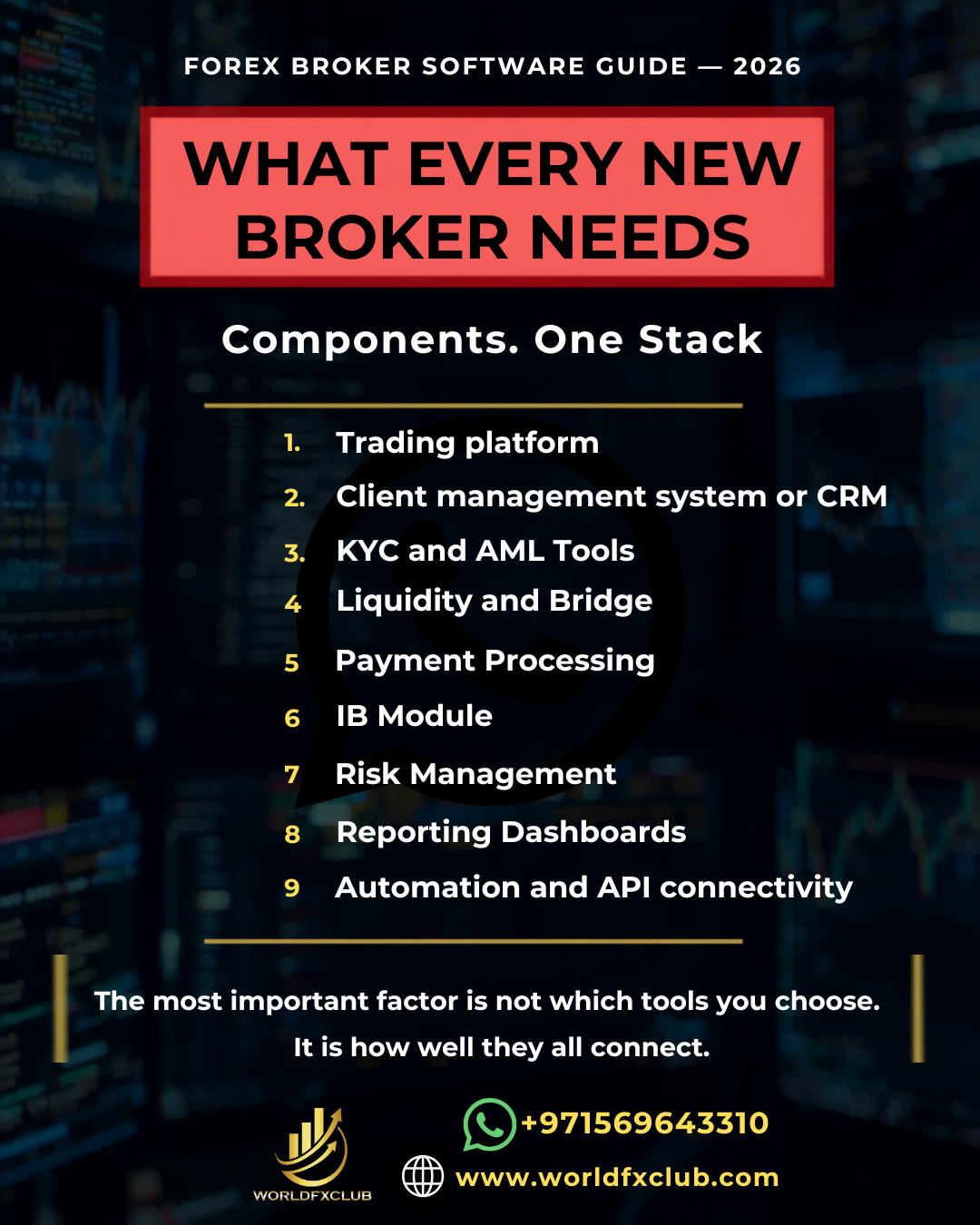
A properly integrated forex broker technology stack typically covers:
- Trading platform — MT4 or MT5
- CRM and back office system
- Client portal and trader’s room
- KYC and AML compliance tools
- Liquidity and bridge solutions
- Payment processing and PSP integration
- IB and affiliate management module
- Risk management tools
- Reporting and analytics dashboard
- Automation and API connectivity
When these components connect and share data correctly, the brokerage operates efficiently. Consequently, when they do not connect — or when manual processes fill the gaps between disconnected systems — the brokerage creates operational problems that scale directly with the client base.
Why Getting the Software Stack Right Matters From Day One
The Cost of Getting It Wrong
Many new forex broker founders underestimate the importance of the software stack at launch. The assumption is that technology can be upgraded later — that the priority is getting to market quickly and optimising the infrastructure once the business is running.
This assumption creates significant problems. A brokerage that launches with a poorly integrated technology stack builds its client base on a foundation that becomes progressively harder to operate as volume increases. Furthermore, migrating clients from one CRM to another, or switching payment processors while maintaining client accounts, creates operational disruption that directly affects client experience and retention.
Consequently, getting the software stack right from day one is not a luxury — it is one of the most important investment decisions a new broker founder makes.
The Integration Principle
The most important principle in forex broker software selection is integration. A broker with ten best-in-class individual tools that do not communicate effectively with each other will consistently underperform a broker with a tightly integrated stack of well-connected tools. Furthermore, poor integration creates manual processes — and manual processes create errors, delays and operational costs that compound as the business grows.
The right question when evaluating any forex broker software component is not just “does it do what I need?” but “does it connect correctly with everything else in my stack?”
Component 1 — The Trading Platform
MT4 and MT5
MetaTrader 4 and MetaTrader 5 remain the most widely deployed trading platforms in the retail forex broker market in 2026. MT5 has emerged as the primary choice for new broker launches — offering multi-asset coverage across forex, CFDs, crypto, commodities and indices from a single platform. Furthermore, MT5 supports more order types, more timeframes, a built-in economic calendar and significantly improved backtesting capabilities compared to MT4.
For new broker founders, MT5 is the recommended starting point in 2026. MT4 remains relevant for brokers with existing client bases who have built their trading strategies and expert advisors on the MT4 infrastructure. However, for a new launch targeting a fresh client base, MT5 provides the stronger technical foundation and the broader asset coverage that modern retail traders expect.
White Label vs Full License
New broker founders have two primary options for accessing MT4 or MT5:
White Label — the recommended starting point for most new brokers
A white label arrangement licenses the trading platform from an existing MetaQuotes licensee and runs it under the new broker’s brand. White label setup costs are significantly lower than a full MetaQuotes license. Furthermore, white label solutions are faster to deploy — making them the most practical option for most new forex broker launches.
Full MetaQuotes License
A full MetaQuotes license gives the broker direct access to the MetaQuotes server infrastructure without the dependency on a white label provider. Full licenses carry significantly higher setup and monthly costs. Consequently, they are more appropriate for established brokers with sufficient trading volume to justify the additional investment.
What the Trading Platform Does Not Do
It is critical to understand that the trading platform — whether MT4 or MT5 white label or full license — is only one component of the brokerage technology stack. It handles the trading environment. However, it does not manage clients, process payments, handle KYC, manage IBs, produce management reports or connect to payment processors. Consequently, every broker needs additional software components around the trading platform to operate a functioning brokerage.
Component 2 — CRM and Back Office System
What a Forex CRM Does
A forex-specific CRM — Customer Relationship Management system — is the operational heart of the brokerage. It manages the complete client lifecycle from initial lead capture through to active trading client management. Furthermore, it connects with the trading platform, payment processors, KYC tools and IB management module — providing a single point of view across the entire client base.
A well-configured forex CRM manages:
- Lead capture and assignment from website and marketing channels
- Client onboarding workflows from initial registration to funded account
- KYC status tracking and document management
- Trading account creation and management
- Deposit and withdrawal processing and reconciliation
- Client communication history and follow-up scheduling
- IB attribution and commission calculation
- Compliance record maintenance
- Management reporting and performance dashboards
Why a Forex-Specific CRM Matters
Generic CRM systems — Salesforce, HubSpot and similar — are not built for forex brokerage workflows. They manage contacts and deals effectively. However, they do not have native understanding of trading accounts, MT5 integration, KYC compliance workflows, PSP reconciliation or IB commission structures.
A forex-specific CRM is built around the actual workflows of a forex brokerage — making it significantly more effective for day-to-day operations than a generic CRM adapted for the purpose. WorldFxClub advises on CRM selection for every new broker client — identifying the right solution for each specific business model and integration requirement.
Component 3 — Client Portal and Trader’s Room
What Clients Need From a Portal
The client portal — sometimes called a trader’s room — is the interface through which clients manage their relationship with the broker. It is separate from the trading platform itself. Consequently, it handles everything the client needs to do outside of actual trading.
A well-designed client portal gives clients access to:
- Personal account details and profile management
- Trading account overview and account opening
- Deposit and withdrawal processing
- Document upload for KYC compliance
- Transaction history and statements
- Support ticket submission and status tracking
- IB portal access for clients who are also introducing brokers
Why Client Portal Quality Matters Commercially
The client portal is the primary touchpoint between the broker and the client for all non-trading interactions. A poorly designed or difficult-to-use portal creates friction at every deposit, withdrawal and account management interaction — directly affecting client satisfaction and retention.
Furthermore, a client portal that integrates poorly with the CRM and payment processor creates manual reconciliation work for the broker’s operations team. Consequently, portal quality is both a client experience issue and an operational efficiency issue — making it one of the most commercially important software decisions a new broker makes.
Component 4 — KYC and AML Compliance Tools
What KYC and AML Software Does
KYC — Know Your Customer — and AML — Anti-Money Laundering — compliance tools manage the identity verification and compliance screening processes that every forex broker must complete before onboarding a client.
KYC and AML software typically handles:
- Identity document collection and verification
- Proof of address verification
- Politically Exposed Person screening
- Sanctions list screening
- Source of funds documentation
- Ongoing transaction monitoring
- Compliance record maintenance and audit trail
The Two Approaches — Manual and Automated
Manual KYC involves a compliance team member reviewing each client’s documents individually. This approach works at low client volumes. However, it does not scale — the cost and time of manual KYC review increases linearly with client volume.
Automated KYC uses software to verify documents, screen against databases and flag exceptions for human review. Consequently, automated KYC scales efficiently — maintaining compliance quality as client volume grows without proportional increases in compliance team headcount.
WorldFxClub advises on KYC and AML compliance tool selection for every new broker client — ensuring the compliance infrastructure meets the requirements of the broker’s chosen jurisdiction and banking partners from day one.
Component 5 — Liquidity and Bridge Solutions
Connecting the Broker to the Market
Every forex broker needs a liquidity provider — the financial institution that provides access to interbank market prices and execution. Furthermore, every broker needs a bridge solution — the technology that connects the trading platform to the liquidity provider’s price stream.
The standard connectivity chain for a modern forex broker is:
Liquidity Provider → FIX API → Bridge → MT5 → Client
The bridge solution is the critical technology that translates between the trading platform’s internal price feed and the liquidity provider’s external price stream. Consequently, bridge quality directly affects execution speed, spread stability and the reliability of the broker’s pricing infrastructure.
Single LP vs Multi-LP Aggregation
Single LP setup — the broker connects to one liquidity provider for all instruments. This is the simplest and lowest-cost setup. However, it creates dependency on a single counterparty for pricing and execution quality.
Multi-LP aggregation — the broker connects to multiple liquidity providers and aggregates the best available price from each. Consequently, multi-LP aggregation delivers tighter spreads, better execution quality and redundancy against individual LP disruptions. This approach is more complex and carries higher costs — but delivers materially better pricing for the client base. WorldFxClub advises on LP relationships and introductions for every new broker client.
Component 6 — Payment Processing and PSP Integration
The Payment Infrastructure Challenge
Payment processing is one of the most operationally complex components of the forex broker technology stack. Clients deposit and withdraw in different currencies using different payment methods — bank wire, card, e-wallet, crypto and local payment methods specific to individual markets.
Furthermore, forex brokers — particularly offshore entities — face elevated scrutiny from payment processors and card schemes. Consequently, securing appropriate payment processing infrastructure is one of the most time-consuming elements of the broker setup process — and one of the most important to get right before the broker launches.
What Payment Integration Covers
A properly integrated payment solution connects:
- PSP and EMI accounts to the CRM for automatic deposit confirmation
- Card processing to the client portal for seamless client deposits
- Crypto payment channels to the CRM for crypto deposit reconciliation
- Bank wire confirmations to the back office for manual reconciliation where required
When payment integration works correctly, a client deposit automatically updates the client’s trading account — without manual intervention from the broker’s operations team. Consequently, payment integration quality directly affects both client experience and operational efficiency.
Component 7 — IB and Affiliate Management Module
Why IB Management Needs Dedicated Software
Introducing Brokers — IBs — are one of the most powerful client acquisition channels for retail forex brokers in the Middle East, Africa and Asia. A well-structured IB network can generate a significant proportion of a broker’s client base at a fraction of the cost of direct paid advertising.
However, managing an IB network without dedicated software becomes progressively more complex and error-prone as the network grows. Manually tracking client attributions, calculating multi-tier commissions and producing IB performance reports across a large partner network is operationally unsustainable.
A dedicated IB management module handles:
- IB registration and onboarding
- Unique referral link generation and tracking
- Client attribution to the correct IB at registration
- Commission calculation — flat, percentage or volume-based
- Multi-tier IB structures — IBs who refer other IBs
- IB performance reporting and dashboards
- Commission payout processing
WorldFxClub advises on IB module selection for every new broker client — ensuring the IB infrastructure can support the specific commission structures and network scale the broker is targeting.
Component 8 — Risk Management Tools
What Risk Management Software Does
Risk management tools give the broker visibility over client trading activity, open positions, margin exposure and overall portfolio risk. Consequently, they are the operational layer that allows the broker to manage its own risk position as the client base trades.
Key risk management functions include:
- Real-time open position monitoring across all client accounts
- Margin level alerts and automatic margin call processing
- Exposure analysis by instrument and client segment
- A-book and B-book flow management
- Stop-out processing when client margin falls below minimum levels
- Liquidity provider hedge position management
Without adequate risk management tools, a broker operating a growing client base cannot maintain accurate visibility over its own risk exposure. Furthermore, inadequate risk management is one of the most common causes of operational crises in retail forex brokerages — making it one of the most important software investments a new broker makes.
Component 9 — Reporting and Analytics
Why Reporting Matters for Broker Growth
A forex brokerage generates substantial operational data every day — leads, registrations, KYC completions, deposits, withdrawals, trades, IB referrals and client communications. Without proper reporting infrastructure, this data sits unused — and the management team makes decisions without the information they need.
A properly configured reporting and analytics setup gives the broker’s management team visibility over:
- Lead volume and source performance
- Registration and KYC completion rates
- Deposit conversion rates and average deposit sizes
- Active client counts and trading volume
- Revenue by client segment and instrument
- IB performance and commission costs
- Withdrawal patterns and processing times
- Client retention and churn rates
Furthermore, reporting that connects across the CRM, trading platform and payment processor gives a complete view of the business — not a fragmented picture assembled from multiple disconnected data sources. Consequently, integrated reporting is a management tool as much as it is an operational one.
Component 10 — Automation and API Connectivity
The Role of Automation in a Modern Brokerage
Automation converts manual operational processes into software-driven workflows — reducing the time and headcount required to manage client onboarding, communication, account management and reporting. Furthermore, automation reduces the error rate associated with manual data entry and process management.
Common automation implementations in forex brokerages include:
- Automated lead assignment to sales team members
- Automated follow-up email sequences for leads at each stage of the funnel
- Automated KYC status notifications to clients
- Automated deposit confirmation and account funding
- Automated IB commission calculation and reporting
- Automated margin call and stop-out notifications to clients
- Automated management reports generated and distributed on schedule
API Connectivity — The Integration Layer
APIs — Application Programming Interfaces — are the technology that allows different software components to communicate and share data. Strong API connectivity is what makes a forex broker technology stack function as an integrated system rather than a collection of disconnected tools.
Key API connections in a forex broker stack include:
- Website to CRM — lead capture and client registration
- CRM to MT5 — account creation and trading data
- CRM to payment processor — deposit and withdrawal confirmation
- MT5 to liquidity provider — pricing and execution
- CRM to reporting tools — operational data aggregation
WorldFxClub advises on technology stack integration for every new broker client — ensuring every component connects correctly and the API layer delivers the integrated operation the business needs.
How to Choose the Right Forex Broker Software in 2026
The Seven Questions Every Founder Must Answer
Before selecting any forex broker software component, every founder should answer these seven questions:
Question 1 — Does it integrate with MT5?
Every software component in the broker stack must integrate cleanly with the trading platform. Non-integrated tools create manual data transfer requirements that undermine operational efficiency.
Question 2 — Does it connect with the payment processors I need?
Payment integration is essential. A CRM that does not connect with the PSPs and EMI accounts the broker uses creates manual reconciliation work on every transaction.
Question 3 — Can it scale with the business?
Software that works well at 100 clients may struggle at 1,000 clients. Evaluate scalability before making any commitment.
Question 4 — Does the CRM support forex-specific workflows?
Generic CRM platforms are not built for forex brokerage operations. A forex-specific CRM is significantly more effective for day-to-day brokerage management.
Question 5 — Does it support the IB commission structures I plan to use?
IB commission structures vary significantly — flat fees, percentage of spread, volume-based tiers and multi-level structures. The IB module must support the specific structures the broker plans to offer.
Question 6 — What support and maintenance is provided?
Brokerage software requires ongoing maintenance, updates and technical support. Evaluate the provider’s support model before any commitment.
Question 7 — What is the total cost of ownership?
The initial setup cost is only one element of the total cost. Monthly fees, per-transaction charges, support costs and upgrade costs all contribute to the total cost of running the software stack over time.
Common Mistakes to Avoid When Choosing Forex Broker Software
Mistake 1 — Choosing on Price Alone
The cheapest software option is rarely the most cost-effective over time. Poor integration, limited scalability and inadequate support create operational costs that consistently exceed the savings made on the initial software investment. Furthermore, migrating to a better system after launching is significantly more expensive and disruptive than choosing the right system from the start.
Mistake 2 — Underestimating Integration Complexity
Many founders assume that two software systems that claim to integrate will integrate seamlessly. In practice, integration quality varies significantly. Consequently, testing the actual integration between components before committing to a software stack is essential — not optional.
Mistake 3 — Ignoring Scalability
Software that works well at the launch volume may not support the business at the target volume. Every software selection decision should be evaluated against the broker’s growth targets — not just the immediate launch requirements.
Mistake 4 — Automating Everything at Once
Automation is powerful but complex. Attempting to automate every process simultaneously at launch creates implementation risk. Furthermore, the most effective automation implementations start with the highest-volume manual processes — the ones causing the most operational pain — and expand from there. Consequently, a phased automation approach consistently delivers better results than a big-bang implementation.
Mistake 5 — Neglecting Security
Forex broker software handles sensitive client personal data, financial data and trading data. Security requirements — access controls, data encryption, backup protocols and penetration testing — must be considered as a non-negotiable part of the software selection process. Furthermore, data security failures in a forex brokerage create regulatory, legal and reputational consequences that can be fatal to the business.
The WorldFxClub Approach — Software Advisory for New Broker Founders
What WorldFxClub Advises On
WorldFxClub advises new forex broker founders on the complete technology stack — from trading platform selection and white label arrangement through to CRM, payment integration, IB module, liquidity connectivity and automation. Our Dubai-based team helps every founder build the right integrated technology foundation for their specific business model and target market.
Specifically, WorldFxClub advises on:
- MT5 white label arrangement — provider selection and setup support
- CRM and back office — forex-specific CRM selection and integration planning
- Client portal — trader’s room selection and brand configuration
- KYC and AML tools — compliance tool selection aligned to jurisdiction requirements
- Liquidity provider introductions — LP relationship development and FIX API connectivity
- Payment processing — PSP and EMI selection and integration planning
- IB module — commission structure design and module selection
- Risk management — risk tool selection and configuration guidance
- Reporting — reporting dashboard setup and integration
- Automation — phased automation planning and implementation guidance
WorldFxClub does not provide setup support and guidance only — our team advises on every software decision before any commitment is made, ensuring every component integrates correctly and the technology stack is built for the specific business model and growth trajectory of each individual broker client.
Frequently Asked Questions
What Forex Broker Software Does a New Broker Need in 2026?
A new forex broker in 2026 needs at minimum a trading platform — MT4 or MT5 white label — a forex-specific CRM and back office system, a client portal, KYC and AML compliance tools, liquidity provider connectivity and a bridge solution, payment processing and PSP integration and an IB management module. Furthermore, risk management tools, reporting dashboards and API connectivity for integration are essential for a broker planning to scale beyond the initial launch phase.
Is MT5 Enough to Run a Forex Brokerage?
No. MT5 provides the trading environment — the platform clients use to place trades. However, it does not manage clients, process payments, handle KYC compliance, manage IBs, calculate commissions or produce management reports. Consequently, every forex broker needs a complete technology stack around the trading platform to operate a functioning brokerage.
What Is the Most Important Software Component for a New Forex Broker?
Integration is the most important factor — more important than any individual software component. A well-integrated forex-specific CRM that connects cleanly with the trading platform, payment processors and IB module delivers more operational value than best-in-class individual tools that do not communicate effectively with each other.
How Much Does Forex Broker Software Cost in 2026?
Software costs vary significantly based on the specific components selected, the provider relationships and the volume commitments made at the time of setup. WorldFxClub provides a precise personalised cost breakdown for each broker’s specific software requirements during the initial free consultation. Contact WorldFxClub via WhatsApp to discuss your specific technology stack requirements and get a realistic cost assessment.
Can WorldFxClub Help With Forex Broker Software Selection and Setup?
Yes. WorldFxClub advises on the complete forex broker technology stack from our Dubai base — trading platform, CRM, client portal, KYC tools, liquidity connectivity, payment integration, IB module, risk management and reporting. Contact WorldFxClub via WhatsApp for a free initial consultation on your specific broker software requirements. Additionally founders who are also setting up their St Lucia IBC offshore structure or Mauritius FSC regulated entity alongside their technology stack can access WorldFxClub’s complete multi-component broker setup advisory from our Dubai base.
WhatsApp WorldFxClub to Discuss Your Broker Software Setup Today
Building the right forex broker technology stack in 2026 requires making the right decisions on ten interconnected software components — and ensuring every one of them integrates correctly with the others. Getting these decisions right from the outset is the difference between a brokerage that scales efficiently and one that rebuilds its technology foundation at significant cost and operational disruption after launch.
WorldFxClub advises on every component of the forex broker software stack from our Dubai base — helping every founder build the right integrated technology foundation for their specific business model, target market and growth trajectory.
Book a free broker software consultation with WorldFxClub Dubai today: